Our Short List of 3

- Dual ES9219C DACs paired with THX AAA-28 amplifiers
- Color IPS display with app control and firmware updates
- Wired and wireless charging support
- 3.5 mm and 4.4 mm outputs for standard and balanced cables
- Outstanding parametric equalizer app with on-board profiles
- Dual ES9219 DACs with LDAC and aptX Adaptive support
- Very light at about 26 grams, with a clip included
- 2.5 mm balanced output alongside the 3.5 mm jack
- Lightest unit here at about 23.5 grams
- Longest battery life, up to 11 hours in low-power mode
- Wide codec support including LDAC and aptX HD
- Built-in microphone for calls and in-line remote support
All 3 Picks at a Glance
| Product | Specs | Action |
|---|---|---|
| FiiO BTR7 |
| Check price on Amazon |
| Qudelix-5K |
| Check price on Amazon |
| FiiO BTR3K |
| Check price on Amazon |
Key takeaways
- Find the best DAC amp for wireless headsets: four Bluetooth DAC amps compared on codecs, output power, battery life and balanced outputs for music on the go.
Introduction
The best DAC amp for wireless headsets solves a very specific problem: you love the sound of your wired headphones, but you hate the wire running to your phone. A portable Bluetooth DAC amp sits in the middle. It pairs wirelessly with your phone, converts the digital signal with its own dedicated converter, amplifies it, and sends it to your wired headphones through a standard headphone jack. Your headphones stay wired to a tiny pocket-sized box, while the box itself talks to your phone with no cable at all.
That distinction matters. The products in this guide are Bluetooth receivers, not Bluetooth transmitters. They receive a wireless signal from a phone, tablet, or laptop and drive wired headphones or earphones. They do not connect to Bluetooth headphones or Bluetooth speakers, because a Bluetooth headset already contains its own DAC and amplifier. What a Bluetooth DAC amp does is give wired headphones the same freedom of movement that wireless headsets enjoy, while adding a better DAC, more power, and support for high-resolution codecs such as LDAC and aptX Adaptive.
This guide covers four portable Bluetooth DAC amps that fit that job: the FiiO BTR15, the FiiO BTR7, the Qudelix-5K, and the FiiO BTR3K. All four are the same type of device, a pocket-sized Bluetooth receiver with a built-in DAC and headphone amplifier. Below you will find a quick comparison, a buying guide, detailed reviews of each unit, and answers to common questions.
At a Glance
| Product | Best for | Key spec |
|---|---|---|
| FiiO BTR15 | Best overall balance of features and portability | Dual ES9219MQ DACs, 340 mW balanced output, LDAC |
| FiiO BTR7 | Most powerful sound with a display | Dual ES9219C DACs with THX AAA-28 amps, wireless charging |
| Qudelix-5K | Deepest app control and equalizer tuning | Dual ES9219 DACs, parametric EQ app, 2.5 mm balanced |
| FiiO BTR3K | Lightest, simplest entry point | Dual AK4377A DACs, 11-hour battery, 23.5 grams |
How to Choose a DAC Amp for Wireless Headset Use
Bluetooth codecs decide how much quality survives the wireless link. LDAC and aptX Adaptive carry more data than basic SBC or AAC, so they preserve more detail from high-resolution files. All four units in this guide support LDAC. Android phones can use LDAC or aptX Adaptive, while iPhone users are limited to AAC by the phone itself, so codec support matters less than output power and DAC quality in that case.
Output power decides which headphones the unit can drive. Output power is measured in milliwatts at a given impedance. Efficient in-ear monitors need very little power, while full-size over-ear headphones with higher impedance need much more. A unit rated around 25 milliwatts single-ended suits earphones and easy-to-drive headphones. A unit rated at 300 milliwatts or more through a balanced output can drive demanding full-size headphones to satisfying volume. Check the impedance and sensitivity of your headphones first, then match the amplifier to them.
Balanced versus single-ended outputs change flexibility. Most headphones use a 3.5 mm single-ended plug. Balanced outputs, usually 4.4 mm or 2.5 mm, deliver more power and better channel separation because each channel gets its own amplifier path. The benefit is real for hard-to-drive headphones, but it requires a headphone cable with the matching balanced plug. Every unit here includes a 3.5 mm output.
Battery life and charging shape daily use. Battery life varies by codec and output: LDAC at high bitrates drains a battery faster than AAC, and balanced output draws more current than single-ended. Look for at least six to eight hours of listening per charge for commuting and travel. USB-C charging is standard on all four models here, and the FiiO BTR7 also supports wireless charging.
A USB DAC mode adds a second job. Every Bluetooth DAC amp in this guide also works as a wired USB DAC when plugged into a phone or computer, so the same small box can serve as a desktop headphone amplifier at work and a wireless receiver on the move. The BTR15 handles PCM up to 384 kHz with native DSD256 in USB mode. If you plan to use the unit at a desk, that wired capability is worth as much as the Bluetooth side.
App control and equalizer support separate good units from great ones. A companion app lets you adjust gain, filters, channel balance, and equalizer settings from your phone. The Qudelix-5K is famous for its parametric equalizer app, and the FiiO BTR15 offers a global parametric equalizer through the FiiO Control app. If you prefer to plug in and listen, a clear on-device display matters more, and the BTR15 and BTR7 both include one.
FiiO BTR15
ASIN: B0CM3NVGYL
The FiiO BTR15 is the strongest all-rounder in this group, combining a bright OLED display, dual DAC chips, balanced output, and a parametric equalizer in a body that weighs about 37.3 grams. It launched in October 2023 as the successor to the popular BTR5, adding a 4.4 mm balanced output and substantially higher output power.
Inside, the BTR15 pairs a Qualcomm QCC5125 Bluetooth chip with an XMOS XU316 USB chip and two ESS ES9219MQ DAC chips. Bluetooth 5.1 supports LDAC up to 96 kHz, aptX Adaptive, aptX Low Latency, aptX HD, AAC, and SBC. In USB DAC mode it decodes PCM up to 384 kHz and native DSD256, with full MQA decoding available in any mode. The 0.96-inch OLED display shows the active codec, sample rate, volume, and battery level at a glance.
Output power is a clear strength. The BTR15 delivers at least 125 milliwatts per channel into 32 ohms from the 3.5 mm single-ended output, and at least 340 milliwatts per channel into 32 ohms from the 4.4 mm balanced output. That balanced figure is enough to drive most full-size headphones. A separate power supply path for the amplifier section keeps the DAC and amplifier from sharing current, which FiiO states reduces noise.
Battery life is rated at about eight hours from the 550 mAh battery, with charging taking under two hours over USB-C. A three-position PC, Bluetooth, and Phone mode switch covers USB DAC operation, Bluetooth receiver operation, and a phone mode that avoids charging conflicts with a connected handset. Dimensions are about 32 by 72.2 by 12.5 millimeters, and the box includes a removable back clip, a USB-C to USB-C cable, and a USB adapter.
Pros:
- Dual ES9219MQ DACs with strong measured output power
- 4.4 mm balanced output alongside the standard 3.5 mm jack
- Clear OLED display showing codec and sample rate
- Global parametric equalizer and MQA full decoding
- USB DAC mode up to 384 kHz and native DSD256
Cons:
- Battery life of about eight hours is shorter than the BTR3K
- No wireless charging, unlike the BTR7
- Slightly heavier and larger than the most compact rivals
FiiO BTR7
- Dual ES9219C DACs paired with THX AAA-28 amplifiers
- Color IPS display with app control and firmware updates
- Wired and wireless charging support
- 3.5 mm and 4.4 mm outputs for standard and balanced cables
The FiiO BTR7 is the premium option in this comparison, built around a three-stage audio architecture that FiiO describes as a high-performance DAC, a low-pass filter, and THX amplification. Each channel gets its own ESS ES9219C DAC chip and its own THX AAA-28 amplifier, a combination designed to capture detail and dynamics with very low distortion.
The BTR7 uses a Qualcomm QCC5124 Bluetooth chip and an XMOS XUF208 USB chip. It supports LDAC, aptX HD, aptX Adaptive, AAC, and SBC over Bluetooth, and decodes PCM up to 384 kHz at 32-bit depth with native DSD256 and MQA support in USB mode. A color IPS display shows volume, codec, battery, and settings, and the FiiO Control app supports remote control plus over-the-air firmware updates.
Charging is a notable advantage. The BTR7 supports both wired USB-C charging and wireless charging, so it can top up on a charging pad between listening sessions. Outputs include a 3.5 mm single-ended jack and a 4.4 mm balanced jack. The body is compact enough for a pocket or a shirt clip, and the display makes it easy to confirm the active codec without opening an app.
One honest limitation comes from FiiO itself: the BTR7 is a Bluetooth receiver, which means it cannot connect to a Bluetooth headphone or speaker. It receives audio from a phone or computer and drives wired headphones. That is exactly the job described in this guide, but buyers who expected a transmitter should understand the distinction before ordering.
Pros:
Cons:
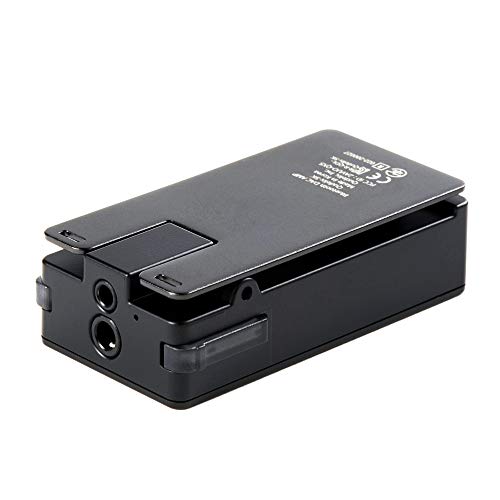
Qudelix-5K
- Outstanding parametric equalizer app with on-board profiles
- Dual ES9219 DACs with LDAC and aptX Adaptive support
- Very light at about 26 grams, with a clip included
- 2.5 mm balanced output alongside the 3.5 mm jack
The Qudelix-5K is the choice for listeners who want to tune their sound precisely. Its companion app offers a full parametric equalizer with per-channel control, crossfeed, and detailed codec and battery readouts, giving owners more adjustment than any other unit in this guide.
The hardware is built around dual ESS ES9219 DAC chips and a Qualcomm QCC5124 Bluetooth chip. It supports LDAC, aptX Adaptive, aptX HD, AAC, and SBC, and it works as a USB DAC when connected to a phone or computer over USB-C. Outputs are a 3.5 mm unbalanced jack and a 2.5 mm balanced jack, so 4.4 mm cable owners will need an adapter or a different cable. The unit weighs about 26 grams, and it includes a clip for attaching to clothing or a bag strap.
The Qudelix-5K has earned a loyal following because the app is actively maintained and the equalizer is genuinely powerful rather than a set of fixed presets. Firmware updates have added features over time, and the device stores EQ profiles on board, so settings travel with the unit rather than living only in the phone. That combination of small size, balanced output, and deep tuning makes it a strong pick for commuters and for listeners who switch between earphones and full-size headphones.
The trade-offs are modest but real. There is no display, so codec and battery information lives in the app rather than on the device. The 2.5 mm balanced output is less common than the 4.4 mm standard used by newer FiiO models. None of that affects sound quality, but buyers who want a screen should look at the BTR15 or BTR7 instead.
Pros:
Cons:
FiiO BTR3K
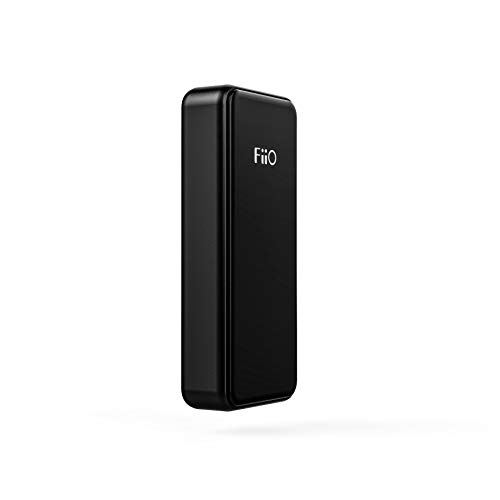
- Lightest unit here at about 23.5 grams
- Longest battery life, up to 11 hours in low-power mode
- Wide codec support including LDAC and aptX HD
- Built-in microphone for calls and in-line remote support
The FiiO BTR3K is the simplest and lightest unit in this guide, and it remains a sensible pick for listeners who mainly use efficient earphones and want the longest battery life. It weighs about 23.5 grams including its battery, measures about 58 by 25 by 11 millimeters, and runs for up to 11 hours in its low-power mode, which is the longest listening time of the four devices covered here.
Inside, the BTR3K uses a Qualcomm CSR8675 Bluetooth chip and two AK4377A DAC chips. Bluetooth 5.0 supports LDAC, aptX HD, aptX Low Latency, aptX, AAC, and SBC. Output power is about 25 milliwatts per channel into 32 ohms from the 3.5 mm single-ended output and about 78 milliwatts per channel into 32 ohms from the 2.5 mm balanced output, with a signal-to-noise ratio of at least 119 dB on the single-ended output. In USB DAC mode it supports sampling rates up to 48 kHz at 16-bit depth.
Practical features include an RGB status light that shows the active Bluetooth codec, a built-in omnidirectional microphone for calls, support for an in-line microphone on CTIA-standard cables, and control through the FiiO Music app. The 330 mAh battery charges in about one and a half hours over USB-C, and the box includes a back clip and a USB-C charging cable.
The honest limitation is power. The BTR3K is designed for earphones and easy-to-drive headphones, and it cannot match the balanced output of the BTR15 or BTR7 on demanding full-size models. For its intended audience, commuters and earphone users who value light weight and long battery life, those limits rarely matter.
Pros:
Cons:
Which One Fits You
The right choice depends on your headphones and how you listen. Choose the FiiO BTR15 if you want the best all-round package: a display, strong balanced power, a parametric equalizer, and full high-resolution USB decoding in one pocket-sized unit. Choose the FiiO BTR7 if sound quality is the top priority and you value the THX amplifier stage, the color display, and wireless charging. Choose the Qudelix-5K if you enjoy tuning your sound, since its parametric equalizer app is the most capable here and its light weight suits all-day carrying. Choose the FiiO BTR3K if you mainly use earphones, want the longest battery life, and prefer the lightest and simplest device.
If you own demanding full-size headphones, narrow the choice to the BTR15 or BTR7 for their balanced output power. If you own efficient in-ear monitors, any of the four will drive them well, and the decision turns on display, app control, and battery life instead. For desk use as well as travel, favor the BTR15 or BTR7 for their stronger USB DAC performance.
Frequently Asked Questions
Can a DAC amp make wireless headsets sound better?
A Bluetooth DAC amp does not connect to a Bluetooth headset, because that headset already has its own built-in DAC and amplifier. Instead, it pairs wirelessly with your phone and drives wired headphones, giving you wireless freedom from the phone with the sound quality of a dedicated DAC and amplifier. If you want better sound from a Bluetooth headset itself, the upgrade path is a better headset.
Do I need a balanced cable to use these DAC amps?
No. Every unit in this guide includes a standard 3.5 mm single-ended output that works with ordinary headphone cables. A balanced cable, in 4.4 mm or 2.5 mm depending on the model, adds more power and channel separation for demanding headphones, but it is optional rather than required.
Will a Bluetooth DAC amp work with an iPhone?
Yes. All four units pair with iPhones over Bluetooth using the AAC codec, and they also work as wired USB DACs with the appropriate adapter cable. iPhones do not support LDAC or aptX, so the highest-resolution wireless codecs here are available to Android phones rather than iPhones.
How long does the battery last on a Bluetooth DAC amp?
Battery life depends on the codec, the output, and the volume. The FiiO BTR3K is rated for up to 11 hours in low-power mode, the FiiO BTR15 for about eight hours, and the other units fall in a similar range for typical listening. LDAC at high bitrates and balanced output both reduce listening time, while AAC and single-ended output extend it.
Can I use a Bluetooth DAC amp as a wired DAC for my computer?
Yes. All four units in this guide work as USB DACs when connected to a phone or computer over USB-C. The FiiO BTR15 and BTR7 offer the strongest wired performance, with PCM decoding up to 384 kHz and native DSD256, while the BTR3K supports up to 48 kHz in USB mode.
Is LDAC really better than AAC or SBC?
LDAC carries more data than AAC or SBC at its highest bitrate, so it can preserve more detail from high-resolution recordings. The difference is most noticeable with good headphones and high-quality source files. With compressed streaming at standard quality, the difference between codecs is smaller.
Conclusion
The best DAC amp for wireless headsets is a Bluetooth DAC amp that frees your wired headphones from the phone. The FiiO BTR15 is the best all-rounder, with a display, strong balanced power, and a parametric equalizer. The FiiO BTR7 is the premium pick, with THX amplification and wireless charging. The Qudelix-5K is the tuner’s choice, with the deepest equalizer app in this group. The FiiO BTR3K is the lightest and longest-lasting option for earphone users. Match the unit to your headphones, check the codec support on your phone, and any of the four will give your wired headphones a genuinely wireless daily life.
Disclosure: As an Amazon Associate, we earn from qualifying purchases.