Key takeaways
- Compare the best ergonomic mice for offices, from the Logitech MX Vertical to the budget Anker vertical, with hand-size and grip notes for every desk.
The best ergonomic mouse for most desks is the Logitech MX Vertical, because its 57-degree handshake angle takes the forearm out of the flat, twisted posture that a standard mouse demands, while its 4000 DPI sensor, rechargeable battery and cross-computer control keep it a full productivity tool rather than a comfort-only compromise. If the hand is small to medium, the Logitech Lift is the same angle in a smaller shell, with quiet clicks and a single AA battery that runs up to two years. A desk with no room to sweep a mouse should look at a trackball instead: the Logitech Ergo M575 is the budget thumb trackball, and the Logitech MX Ergo S is the premium one, with an adjustable tilt hinge and six programmable buttons. And the Anker 2.4G wireless vertical mouse is the budget way to find out whether a vertical shape suits the hand at all, a simple five-button mouse with three sensitivity steps and no software to install. One honest note up front: four of the five picks carry the Logitech name, because that maker currently dominates the ergonomic mouse category, and the Anker is the one non-Logitech pick in the guide. Below, we compare five verified mice across shape, hand fit, connection and power, so the choice rests on the hand and the desk rather than on the shape that looks most dramatic in a photograph. One scope note: every pick here is a right-handed mouse for ordinary office work, documents, spreadsheets and browsing; none of them is a gaming mouse, and none of them is made for left-handed use.
As an Amazon Associate, we earn from qualifying purchases.
Table of Contents
- Quick Picks at a Glance
- Quick Comparison
- How to Choose an Ergonomic Mouse
-
- Logitech MX Vertical Wireless Mouse
-
- Logitech Lift Vertical Ergonomic Mouse, Graphite
-
- Logitech Ergo M575 Wireless Trackball Mouse, Graphite
-
- Logitech MX Ergo S Advanced Wireless Trackball Mouse, Graphite
-
- Anker 2.4G Wireless Vertical Ergonomic Optical Mouse
- Care and Safety Tips
- Frequently Asked Questions
- Conclusion
- Product and ASIN Reference
Quick Picks at a Glance
- Best overall: Logitech MX Vertical — a 57-degree handshake angle, a 4000 DPI sensor and a rechargeable battery, for medium to large hands.
- Best for smaller hands: Logitech Lift Vertical, Graphite — the same 57-degree angle in a smaller shell, with quiet clicks and a two-year AA battery.
- Best budget trackball: Logitech Ergo M575, Graphite — a thumb trackball that never moves across the desk, with Bluetooth and a two-year battery.
- Best premium trackball: Logitech MX Ergo S, Graphite — an adjustable tilt hinge, six programmable buttons and USB-C charging.
- Best budget vertical: Anker 2.4G Wireless Vertical — the cheapest honest way to try a vertical shape, with three sensitivity steps and no software.
Quick Comparison
| Product | Form | Angle | Sensor | Connection | Power | Tier |
|---|---|---|---|---|---|---|
| Logitech MX Vertical | Vertical mouse | 57 degrees | 4000 DPI | Bluetooth, Unifying receiver | USB-C rechargeable | Premium |
| Logitech Lift Vertical, Graphite | Vertical mouse | 57 degrees | 4000 DPI | Bluetooth, Logi Bolt receiver | 1 AA, up to 24 months | Mid-range |
| Logitech Ergo M575, Graphite | Thumb trackball | Not stated | Not stated in the listing data reviewed | Bluetooth, Unifying receiver | 1 AA, up to 24 months | Budget |
| Logitech MX Ergo S, Graphite | Thumb trackball | 0 to 20 degree tilt | Not stated in the listing data reviewed | Bluetooth, Logi Bolt receiver | USB-C rechargeable | Premium |
| Anker 2.4G Wireless Vertical | Vertical mouse | Not stated by the maker | 800, 1200, 1600 DPI | 2.4 GHz receiver only | 2 AAA, not included | Budget |
How to Choose an Ergonomic Mouse
Start with the form, because the form is the ergonomics. A vertical mouse stands the hand on its side in a handshake posture, which rotates the forearm out of the flat, palm-down position that loads the wrist over a long day. The MX Vertical and the Lift both hold that posture at a published 57-degree angle, and the Anker holds a steep vertical posture too, though its maker publishes no angle figure, which is itself a finding worth knowing before buying. A trackball takes a different route to the same goal: the hand stays still and the thumb rolls a ball, so the wrist never sweeps across the desk at all. The M575 and the MX Ergo S are both thumb trackballs, and the MX Ergo S adds a hinge that tilts the whole body between flat and 20 degrees, so the hand can sit at the angle that feels best rather than the one the shell imposes. Neither form is right for every hand: a vertical mouse still moves, so it needs desk space to travel in, and a trackball never moves, so it suits a crowded desk but asks the thumb to do all of the pointing work. Choose the form by the desk first and the hand second, and the rest of the comparison falls into place.
Hand size comes second, and it is the figure buyers skip most often. The MX Vertical is built for medium to large right hands, and its tall shell needs palm room that a compact mouse never asks for; a small hand on the MX Vertical will stretch to reach the buttons and lose the benefit of the angle. The Lift exists for exactly that hand, the same 57-degree angle in a smaller shell sized for small to medium hands, and it is the pick for anyone who found the MX Vertical too tall. The Anker sits between the two in size but runs large for its class, and owners with smaller hands report it feeling oversized, so a small hand should treat the Anker as a trial rather than a fit. The trackballs are more forgiving on size because the hand rests on the shell rather than gripping it, but they are right-hand only, and a left-handed buyer has no pick in this guide. Measure the hand against the maker’s stated fit before ordering, and treat any mouse whose hand fit is not published as a mouse to check on the live page.
Connection comes third, and the choice is between Bluetooth, a USB receiver, or both. The MX Vertical, the Lift, the M575 and the MX Ergo S all offer Bluetooth plus a receiver, which means they pair with a laptop over Bluetooth and still work on a locked-down office desktop through the dongle, and the Lift and the MX Ergo S use the newer Logi Bolt receiver while the MX Vertical and the M575 use the older Unifying receiver. The Anker is the exception: a 2.4 GHz receiver only, with no Bluetooth at all, so it needs a free USB-A port and cannot pair with a tablet or a USB-C-only laptop without an adapter. That single-channel design is also the Anker’s strength on a corporate desk, because it works the moment the receiver is plugged in, with no pairing and no software. A buyer who switches one mouse between two computers should favor the MX Ergo S, which carries a dedicated switch for two computers, or the MX Vertical, which moves the cursor between computers through the maker’s Flow control.
Power comes fourth, and it divides the guide into two camps. The MX Vertical and the MX Ergo S recharge over USB-C, with the MX Vertical running up to four months on a full charge and gaining three hours of use from a one-minute quick charge, so neither mouse needs a battery drawer. The Lift and the M575 run on a single AA battery for up to 24 months, which means no charging cable and no dead-mouse afternoon, only a battery swap every couple of years. The Anker runs on two AAA batteries, which are not included, and enters a power-saving mode after eight minutes of inactivity, waking on a click. None of these is objectively better: a rechargeable mouse is tidier and a battery mouse is never tethered to a cable, and the honest question is whether the desk has a spare USB-C cable and the habit of charging, or a drawer with AA batteries in it.
Buttons and software come last, because they decide what the mouse does beyond pointing. The MX Ergo S leads here with six programmable buttons and a precision mode button that slows the cursor for fine work, and the Lift offers six buttons with four customizable through the maker’s software. The MX Vertical and the M575 carry back and forward thumb buttons plus a scroll wheel, and the MX Vertical adds a cursor-speed switch on top. The Anker is the simplest of the five, five buttons with forward and back on the thumb and a DPI switch, and no software at all, which suits a buyer who wants the shape without a settings panel. A buyer who lives in spreadsheets and documents should weigh the programmable buttons heavily; a buyer who points, clicks and scrolls should not pay for them.
1. Logitech MX Vertical Wireless Mouse

Tier: Premium
The MX Vertical is the best overall ergonomic mouse because it pairs the category’s most studied shape with a full productivity feature set. The 57-degree vertical angle holds the hand in a natural handshake position, and the maker’s own published claim is that the posture reduces muscular activity by ten percent compared with a standard mouse, without any loss in tracking performance. The 4000 DPI high-precision sensor means the cursor crosses a wide monitor with less hand movement, which matters on a large display where a low-sensitivity mouse asks the wrist to travel. The rechargeable battery runs up to four months on a full charge, and a one-minute quick charge returns three hours of use, so a dead battery is a minute’s interruption rather than an afternoon’s. Bluetooth and the included Unifying receiver cover both connection routes, and the Flow control moves the cursor and copied text between two computers, which suits a desk with a work laptop and a personal machine side by side.
The published figures back the design up. The listing data reviewed gives the size as about 4.72 inches long by 3.11 inches wide by 3.09 inches tall, and the weight as about half a pound, which is a tall, substantial shell that fills a medium or large palm. The Graphite listing is the one pinned in the reference table below, and the listing data reviewed carries the identifier for that exact listing. The buttons are left and right click, back and forward on the thumb, a cursor-speed switch on top, and a scroll wheel, which is a complete office set without reaching for software. The shape suits medium and large right hands, and the listing is explicit that the fit is for those hands, which is a strength: a mouse that states its hand fit is a mouse that can be bought with confidence rather than guessed at.
The qualifications are about fit and habit rather than function. A small hand on the MX Vertical will stretch for the buttons and lose the benefit of the angle, and that hand belongs on the Lift below instead. The tall shell needs desk space behind it, since a vertical mouse still travels across the desk, and a crowded desk that cannot spare the sweep should look at a trackball. And the premium tier is real: this is the most expensive vertical mouse in the guide, priced against the Anker below, which does the same basic shape for a fraction of the commitment. What the money buys is the published angle, the high-precision sensor, the rechargeable battery, the multi-computer control and the build quality that has kept this listing selling since 2018. For a medium or large hand that works at a desk all day, that is a coherent place for it to sit.
Specs
- Form: Vertical mouse, 57-degree angle
- Sensor: 4000 DPI high-precision sensor
- Connection: Bluetooth and included Unifying USB receiver
- Power: USB-C rechargeable, up to 4 months per charge
- Quick charge: 1 minute for 3 hours of use
- Hand fit: Medium to large right hands
- Dimensions: About 4.72 x 3.11 x 3.09 in, per the listing data reviewed
- Weight: About 0.5 lb, per the listing data reviewed
- Buttons: Left, right, back, forward, cursor-speed switch, scroll wheel
- Color: Graphite, per the pinned listing
2. Logitech Lift Vertical Ergonomic Mouse, Graphite
Tier: Mid-range
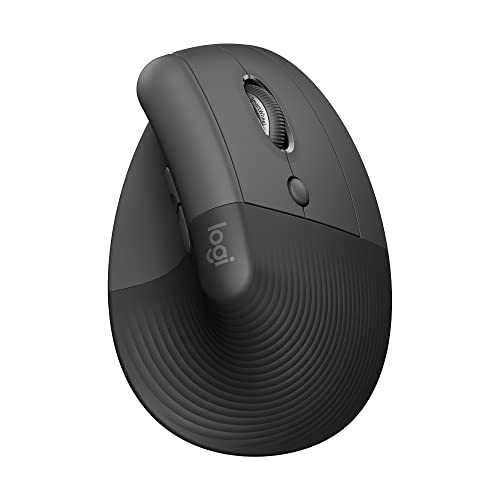
The Lift is the same 57-degree handshake angle as the MX Vertical, rebuilt for the hand the MX Vertical is too tall for. Its case starts with fit: the shell is sized for small to medium right hands, and a buyer who found the MX Vertical oversized will find the Lift’s lower, narrower body sits under the palm without asking the fingers to stretch. The sensor is the same 4000 DPI unit as the MX Vertical, so the cursor behavior does not change with the smaller shell, and the quiet clicks are the second part of the case, a softer click that suits a shared office or a home desk where someone else is working nearby. The power story is different from the MX Vertical and better for some desks: a single AA battery that runs up to 24 months, which means no charging cable, no charging habit, and no afternoon when the mouse dies mid-sentence.
The connection set is current rather than carried over. The Lift pairs over Bluetooth or the included Logi Bolt USB receiver, the maker’s newer receiver standard, and it carries six buttons with four customizable through the maker’s software, so the thumb buttons and the scroll wheel can be set to the shortcuts the desk actually uses. The scroll wheel is the maker’s SmartWheel design, which shifts between precise and fast scrolling, and that matters on long documents where a ratcheted wheel asks for too many turns. The listing data reviewed carries the identifier for the Graphite listing, which is the one pinned in the reference table below, and other colors exist under their own listings, including an Off White and a Rose variant that are judged elsewhere, not here.
The qualifications are about what the smaller shell gives up. The Lift does not recharge, so a buyer who dislikes disposable batteries should be on the MX Vertical instead, and it does not carry the MX Vertical’s cross-computer Flow control, so a two-computer desk should weigh that loss. The quiet clicks are a genuine benefit in a shared room and a non-event in a private one, and the six buttons are only an advantage if the software gets opened and the buttons get set. Within those fences, this is the ergonomic mouse for the smaller hand, because it is the only one in this guide that keeps the published 57-degree angle in a shell that hand can actually hold.
Specs
- Form: Vertical mouse, 57-degree angle
- Sensor: 4000 DPI
- Connection: Bluetooth and included Logi Bolt USB receiver
- Power: 1 AA battery, up to 24 months
- Clicks: Quiet clicks
- Buttons: 6, with 4 customizable through the maker’s software
- Scroll wheel: SmartWheel design
- Hand fit: Small to medium right hands
- Color: Graphite, per the pinned listing
3. Logitech Ergo M575 Wireless Trackball Mouse, Graphite

Tier: Budget
The M575 is the budget trackball, and its case starts with the one thing no moving mouse can offer: the hand never travels. The thumb rolls a blue trackball while the hand rests on a sculpted shell, so the wrist stays in one place all day and the desk needs no sweep space at all, which suits a crowded desk, a small desk, or a desk where the mouse lives between the keyboard and a stack of papers. The connection set is the same dual route as the MX Vertical, Bluetooth plus the included Unifying receiver, and the power story matches the Lift, a single AA battery that runs up to 24 months, so the mouse asks nothing of the desk beyond a battery swap every couple of years. The sculpted shape keeps the hand in a relaxed, slightly raised posture rather than flat on the desk, and that posture is the whole ergonomic argument: less wrist extension, less forearm rotation, and no sweeping at all.
The listing data reviewed carries the identifier for the Graphite listing, which is the one pinned in the reference table below. The buttons are left and right click, back and forward on the thumb, and a scroll wheel, which is the standard office set, and the trackball itself is the pointing device, so the index and middle fingers rest while the thumb does the moving. The newer M575S generation exists with a quieter click and the Logi Bolt receiver, and it sells under its own listing; the original M575 here is the budget entry, and its listing was confirmed live on Amazon in a November 2026 roundup, which is the evidence pinned in this guide. A buyer who wants the quieter click and the newer receiver should look at the M575S listing and judge it on its own terms, not as a color variant of this one.
The qualifications are about the thumb. A trackball asks the thumb to do all of the pointing, and a thumb that is itself sore will not thank the buyer for the transfer of work, so a sore thumb belongs on a vertical mouse instead. The ball needs cleaning, since dust and skin oil collect in the socket and the cursor will stutter until the ball is lifted out and the socket wiped, which is a minute’s maintenance that a moving mouse never asks for. And the M575 is right-hand only, with no left-handed version, which is a hard limit rather than a preference. For a crowded desk and a healthy thumb, though, this is the cheapest honest way into the trackball form, and the two-year battery means it stays cheap to run as well as cheap to buy.
Specs
- Form: Thumb trackball, sculpted ergonomic shape
- Connection: Bluetooth and included Unifying USB receiver
- Power: 1 AA battery, up to 24 months
- Trackball: Blue ball, thumb-operated
- Hand fit: Right hand only
- Buttons: Left, right, back, forward, scroll wheel
- Color: Graphite, per the pinned listing
4. Logitech MX Ergo S Advanced Wireless Trackball Mouse, Graphite

Tier: Premium
The MX Ergo S is the premium trackball, and its case starts with the hinge. The body tilts on an adjustable hinge between flat and 20 degrees, so the hand can sit at the angle that feels best rather than the one the shell imposes, which is the one adjustment no other trackball in this guide offers. The thumb trackball itself is the same idea as the M575, the hand stays still and the thumb points, but the MX Ergo S adds six programmable buttons, a precision mode button that slows the cursor for fine work on dense documents and timelines, and a two-computer switch that moves the pointer between machines. The clicks are quieter than the original MX Ergo, which suits a shared desk, and the battery recharges over USB-C, so there is no battery drawer and no disposable to buy.
The connection set is the current standard: Bluetooth plus an encrypted Logi Bolt USB receiver, which is the maker’s newer, secured receiver rather than the older Unifying one. The listing data reviewed shows the mouse sold by Amazon.com, and the identifier for the Graphite listing is the one pinned in the reference table below. The listing data reviewed carries the model as the MX Ergo S, the successor to the original MX Ergo, and the two should not be confused: the original MX Ergo sells under its own listing with the older receiver and a micro-USB charge port, while the S carries the Logi Bolt receiver, USB-C charging and quieter clicks. A buyer comparing the two should check the receiver and the charge port on the listing, because those two details are the fastest way to tell them apart.
The qualifications are about commitment. This is the most expensive trackball in the guide, and its advantages, the tilt hinge, the programmable buttons, the precision mode and the two-computer switch, are only advantages if they get used; a buyer who points, clicks and scrolls should save the money and buy the M575. The trackball still asks the thumb to do the pointing, and the ball still needs the occasional cleaning, and the mouse is right-hand only. The USB-C cable is not included, which the maker states plainly, so a desk without a spare cable will need one. For a desk where the trackball is the daily tool rather than an experiment, though, the hinge alone justifies the tier: a trackball that adjusts its own angle is a trackball that fits more hands than a fixed one ever will.
Specs
- Form: Thumb trackball with adjustable tilt hinge, 0 to 20 degrees
- Buttons: 6 programmable buttons, plus a precision mode button
- Connection: Bluetooth and encrypted Logi Bolt USB receiver
- Power: USB-C rechargeable; charging cable not included
- Computer switching: Dedicated switch for 2 computers
- Clicks: Quieter than the original MX Ergo
- Hand fit: Right hand only
- Color: Graphite, per the pinned listing
5. Anker 2.4G Wireless Vertical Ergonomic Optical Mouse

Tier: Budget
The Anker is the budget vertical mouse, and its case starts with the price of entry: the cheapest honest way to find out whether a vertical shape suits the hand, without committing to a premium mouse first. The shape is a steep vertical shell that holds the hand in a handshake posture, with five buttons, forward and back on the thumb, and three sensitivity steps at 800, 1200 and 1600 DPI, switched from the top of the mouse. The connection is a single 2.4 GHz USB receiver, plug and play, with no Bluetooth and no software, which means it works the moment the receiver is plugged in and works on a locked-down office desktop where pairing and installs are blocked. Two AAA batteries power it, the receiver stores in the underside of the mouse for travel, and the maker covers it with an 18-month warranty, which is longer than the one-year term on either Logitech vertical in this guide.
The listing data reviewed carries the identifier for the Black listing, which is the one pinned in the reference table below, and the listing states that the mouse is not discontinued by the manufacturer, which matters because the design dates to 2013 and has not changed since. The published dimensions are about 4.72 inches long by 2.47 inches wide by 2.94 inches tall, and the weight is 3.4 ounces, which makes it a large shell for its class, and owners with smaller hands report it feeling oversized. The mouse enters a power-saving mode after eight minutes of inactivity and wakes on a click, and the AAA batteries are not included, so the first use needs two batteries from the drawer. The listing was confirmed in stock on Amazon in a review updated the day before this guide was written, which is the freshest stock evidence in the lineup.
The qualifications are about what the low commitment costs. There is no Bluetooth, so a tablet or a USB-C-only laptop needs an adapter for the receiver, and the thumb buttons are not recognized on macOS, which the maker states plainly, so a Mac desk should treat the side buttons as Windows-only. The sensor tops out at 1600 DPI, which is fine for documents and browsing and thin for a wide, high-resolution monitor. The maker publishes no grip angle for this mouse, so the defining measurement of a vertical mouse is blank here, and the often-repeated right-angle figure has no maker source and is not printed in this guide. And the design’s age is real: a mouse designed in 2013 and never revised will not have the refinement of the Logitech picks, and owner feedback reports recurring issues with buttons and scrolling over long use. As a trial, though, it is the right purchase: if the vertical shape helps, the buyer upgrades to the MX Vertical or the Lift knowing why, and if it does not, the experiment cost the budget tier rather than the premium one.
Specs
- Form: Vertical mouse; grip angle not stated by the maker
- Sensor: 800, 1200, 1600 DPI, switchable
- Connection: 2.4 GHz USB receiver only; no Bluetooth
- Buttons: 5, including forward and back on the thumb
- Power: 2 AAA batteries, not included
- Power saving: Enters power-saving mode after 8 minutes of inactivity
- Dimensions: 4.72 x 2.47 x 2.94 in, per the listing data reviewed
- Weight: 3.4 oz, per the listing data reviewed
- Warranty: 18 months, per the maker
- Color: Black, per the pinned listing
Care and Safety Tips
A mouse is a low-voltage peripheral, and two habits decide whether it stays a comfortable one. First, cleaning: a vertical mouse collects skin oil on the grip and dust on the sensor window, and the fix is a dry cloth over the shell and a puff of air across the sensor, never a solvent and never liquid in the seams. A trackball asks for one more step, lifting the ball out of its socket and wiping the socket clean, because dust in the socket is the usual cause of a stuttering cursor, and a ball that is never cleaned will feel worse than a mouse that is never cleaned. Second, batteries: a rechargeable mouse uses a sealed cell that should never be punctured or opened, and a battery mouse should have its spent AA or AAA cells removed rather than left to leak in the compartment. A mouse that smells hot, swells, or stops holding a charge belongs in the maker’s support channel, not on the desk for another week.
On recalls, the precise record is reassuring for this category: no CPSC recall covers ergonomic mice as a product class, and none covers any of the five mice in this guide. The adjacent records on the federal and international books concern different products. A January 2016 voluntary manufacturer recall by BenQ covered the ZOWIE EC, FK and ZA series gaming mice over switch reliability, with random double-clicks reported, which is a gaming-mouse quality action by a different maker, not a safety recall, and none of the five picks is a ZOWIE mouse. A November 2026 EU Safety Gate notice from Sweden, numbered SR/03132/26, had listings removed for an unnamed generic wireless mouse over lead and cadmium in the solders and a plasticizer in the USB cord plastic, which is a no-brand product sold through marketplaces in Europe, not a named-brand mouse, and none of the five picks is that product. A June 2025 UK product safety notice covered a black heated mouse pad sold through Amazon, which overheated because it had no temperature control, which is a heated pad, not a mouse, and no pick in this guide is a heated accessory. The Anker power-bank recalls that appear in the news cover power banks only, not mice, and the Anker pick here is a mouse with no battery pack in it. A buyer who encounters a warning about a recalled desk accessory should check it against the accessory, not the mouse; the mouse’s own safety questions begin and end with the cleaning and battery notes above.
Frequently Asked Questions
Do vertical mice actually help wrist pain?
A vertical mouse changes the posture, not the workload, and that distinction decides whether it helps. Holding the hand in a handshake position rotates the forearm out of the flat, palm-down posture that loads the wrist, and the MX Vertical’s maker publishes a ten percent reduction in muscular activity for that posture compared with a standard mouse. What a vertical mouse does not do is reduce the hours: eight hours of pointing is eight hours of pointing in any posture, and a mouse cannot fix a chair that is the wrong height or a keyboard that forces the shoulders up. Buy the shape for the posture, then fix the chair height and take the breaks, because the mouse is one part of the desk rather than the whole answer.
Is a trackball better than a vertical mouse?
It depends on the desk and the thumb. A trackball wins on a crowded desk, because the hand never moves and the mouse needs no sweep space, and it wins for a wrist that hurts when it sweeps, because the wrist stays still while the thumb points. A vertical mouse wins for a thumb that is itself sore, because the thumb does no more work than on a standard mouse, and it wins for fine, fast pointing across a wide monitor, because moving the whole hand is more precise than rolling a ball for most people. The honest test is a week with one form: if the thumb tires first, the trackball is the wrong form, and if the wrist tires first, the vertical mouse is the wrong form.
Should I choose Bluetooth or a USB receiver?
Choose both if the desk allows it, which four of the five mice in this guide offer. Bluetooth pairs with a laptop and leaves every USB port free, while a receiver works on a locked-down office desktop where Bluetooth is disabled and installs are blocked, and it connects the moment it is plugged in. The Anker is receiver-only, which is a limitation on a tablet or a USB-C-only laptop, and a strength on a corporate desktop, where it simply works. A buyer with one computer and a free USB-A port loses nothing to a receiver-only mouse; a buyer who moves between a laptop and a tablet should buy a mouse with Bluetooth.
How do I know which size ergonomic mouse fits my hand?
Start with the maker’s stated fit, not the photograph. The MX Vertical is built for medium to large right hands and the Lift for small to medium right hands, and those two statements cover most desks between them. A hand that spans the MX Vertical’s shell without stretching is the right hand for it, and a hand that has to reach for the buttons belongs on the Lift. The Anker runs large for its class, so a smaller hand should treat it as a trial, and the trackballs are more forgiving on size because the hand rests on the shell rather than gripping it. If the listing states no hand fit, treat the mouse as a trial purchase and confirm the return terms before ordering.
Conclusion
An ergonomic mouse purchase is decided by three questions and one habit: which form the desk allows, which hand size the shell is built for, and which connection the computers need, plus the habit of cleaning the sensor or the trackball socket before blaming the mouse. If the hand is medium to large and the desk has room to sweep, the Logitech MX Vertical is the complete answer, the published angle, the high-precision sensor and the rechargeable battery in one mouse. If the hand is small to medium, the Logitech Lift keeps the same angle in a smaller shell with quiet clicks and a two-year battery. A crowded desk should buy a trackball, the Logitech Ergo M575 at the budget tier or the Logitech MX Ergo S at the premium tier with its tilt hinge and programmable buttons. And the Anker 2.4G wireless vertical is the budget trial, for the buyer who wants to find out whether a vertical shape helps before paying for the premium one. Match the form to the desk first, the size to the hand second, and every pick above will do what its listing promises.