Key takeaways
- Best battery for trailer winch use compared: deep-cycle 12V options by capacity, discharge limit, group size and weight, plus wiring and charging guidance.
As an Amazon Associate we earn from qualifying purchases.
Affiliate Disclosure: This article contains affiliate links. If you buy through a link on this page, we may earn a commission at no extra cost to you. Product details are taken from the manufacturer and Amazon US product listings, and availability should be checked again at the time of purchase.
A trailer winch does not ask for power the way a starter motor does, and it does not sip power the way a dome light does either. It sits in between, and that in-between job is exactly why so many trailer batteries disappoint. A winch under load pulls a heavy current for minutes at a time, rests, then pulls again while you reposition a strap, check a ramp angle, or winch a dead vehicle the last few feet onto the deck. A starting battery is built for a short, violent burst and then immediate recharging from an alternator. Repeated winching drains it far deeper than it was designed to go, and its thin plates suffer for it. A deep-cycle battery is built for the opposite pattern: sustained draw, a meaningful depth of discharge, and then a proper recharge, over and over again.
That is the filter used here. Each product below is a 12-volt deep-cycle battery of the type used on trailers, in RVs, and on boats, not a starting battery. We have compared them on the things that actually decide a winching session: usable capacity in amp-hours, the continuous discharge limit where the listing states one, group size and fit in a trailer battery box, weight on the tongue, and how the battery wants to be recharged between trips. We have not tested these batteries ourselves, and no practical claim is made anywhere in this article. All specifications come from the product listings and manufacturer information cited for each pick.
One warning belongs at the very front, because it decides whether a lithium pick is right for you at all. Many 12-volt lithium iron phosphate batteries in this class carry a battery management system rated around 100 amps of continuous discharge. A mid-size trailer winch can draw well above that figure at full load near the end of a pull, when only a few wraps of line remain on the drum. If your winch maker lists a full-load draw above the discharge limit of a battery you are considering, that battery is the wrong match no matter how attractive its weight and cycle life look. Check the winch manual first, then choose the battery. The picks below explain, for each model, where that limit sits and what kind of winching it suits.
Quick comparison
All four picks are lithium iron phosphate deep-cycle units in the 100 amp-hour class, a class that offers clear, well-documented listings for trailer use and a realistic reserve for several loaded pulls plus trailer lights and a jack on the same circuit in many setups. The buying guide below covers when a traditional absorbed glass mat deep-cycle battery still makes sense for very heavy winch draws.
- Renogy 12V 100Ah LiFePO4 with Bluetooth: the best-documented pick, with a stated 100-amp continuous discharge and monitoring built in.
- BougeRV 12V 100Ah Group 24 LiFePO4: a Group 24 drop-in shape with low-temperature charge protection, listed for RV, trailer, and marine use.
- Timeusb 12V 100Ah Group 24 LiFePO4: another Group 24 fit, with a stated 100-amp management system and a long stated cycle life.
- GREENOE 12V 100Ah Group 31 LiFePO4: a larger Group 31 case for trailers with a bigger box.
1. Renogy 12V 100Ah Lithium LiFePO4 Deep Cycle Battery with Bluetooth
Renogy is the name most trailer owners will already know from solar and RV power, and this 100 amp-hour lithium battery is the most fully documented pick in this guide. The listing gives a rated capacity of 100 amp-hours at a nominal 12.8 volts, a maximum continuous discharge current of 100 amps, and a maximum continuous charging current of 50 amps. Dimensions are listed at about 11.4 by 6.8 by 7.4 inches, and weight is listed at about 26 pounds. For a battery that replaces a lead-acid unit of similar capacity at roughly double the weight or more, that figure matters on a trailer, where every pound in a tongue-mounted box is a pound the tow vehicle carries on its hitch.
The listing describes an integrated smart battery management system that monitors and manages charging and discharging and protects against common abnormalities, and it states a cycle life of more than 4,000 cycles at the stated test conditions in one part of the listing and more than 2,000 deep cycles in the product title. Treat the more conservative reading as the planning figure. Bluetooth monitoring is the practical advantage on a trailer: you can check state of charge from the tow vehicle or from beside the ramps without lifting the battery box lid and putting a meter on the terminals, which is exactly the moment, mid-loading, when nobody wants extra steps.
For winching, be precise about the fit. With a stated 100-amp continuous discharge limit, this battery suits small to mid-size trailer winches whose loaded draw stays within that envelope, intermittent pulls with rest periods, and mixed trailer duty where the same battery also runs lights, a power jack, and accessories. If your winch is a heavy unit rated for pulling full-size trucks onto the trailer and its manual lists a much higher full-load draw, do not force this match. Either step up to a battery bank and configuration the winch maker approves, or choose a high-discharge absorbed glass mat deep-cycle battery instead. Renogy also states that these batteries should not be strung in series and that parallel connections should use the same manufacturer and model, guidance worth following exactly if you build a two-battery bank to share winch load.
Charging deserves the same care. Use a charger with a lithium iron phosphate profile and respect the stated 50-amp maximum charging current.
2. BougeRV 12V 100Ah Group 24 LiFePO4 Battery
The BougeRV pick earns its place on shape and cold-weather protection. It is listed as a Group 24 battery, which is the footprint many trailer and RV battery boxes were already built around, so it is the closest thing here to a drop-in replacement for an older Group 24 lead-acid deep-cycle battery. The listing gives 12.8 volts, 100 amp-hours of capacity, a built-in 100-amp battery management system, and stored energy of 1,280 watt-hours. Vehicle service type is listed as RV and trailer, and the battery cell composition is listed as lithium phosphate.
Low-temperature protection is the headline feature, and it is a real one for trailer work. Lithium batteries should not be charged below freezing, and a trailer that lives outside through winter will see those temperatures regularly. A management system that blocks a damaging cold charge protects the investment in a way that a bare specification sheet for capacity never shows. If you winch in shoulder seasons, move equipment in winter, or store the trailer unheated, that protection moves this battery up the list even though its core capacity matches the other picks.
The same discharge honesty applies here as with the Renogy. A built-in 100-amp management system means the practical winching envelope is light to mid-duty pulls within the winch maker stated draw, with pauses between pulls, rather than sustained maximum-load recovery work. Within that envelope, the benefits are the familiar lithium ones: far less weight than the lead-acid battery it replaces, a much deeper usable share of its rated capacity, and no watering or terminal corrosion routine of the kind flooded batteries demand. The listing describes the battery as maintenance-free deep-cycle power for RV, marine, trolling motor, and solar backup use, all of which share the sustained-draw pattern that winching belongs to.
Check your box before ordering. Group 24 is a footprint, not a guarantee that every lid, hold-down, and cable length in an older trailer box will suit a new battery with its own terminal layout. Measure the box, confirm terminal orientation, and plan cable routing so the winch leads reach without strain or sharp bends.
3. Timeusb 12V 100Ah LiFePO4 Battery, BCI Group 24
Timeusb competes on stated cycle life and value within the same Group 24, 100 amp-hour format. The listing describes a 12.8-volt, 100 amp-hour lithium iron phosphate battery with a built-in 100-amp battery management system, 1,280 watt-hours of energy, and a maximum stated figure of 15,000 cycles at the conditions described in the listing, alongside a stated lifespan of more than ten years. As with every cycle claim in this class, read it as a laboratory figure at a specified depth of discharge rather than a promise for winch duty, where deep, heavy pulls are harder service than a gentle solar cycle. Even discounted heavily, the underlying point stands: lithium iron phosphate chemistry is rated for far more deep cycles than a comparable lead-acid deep-cycle battery.
The listing states a weight of about 21 pounds and describes the battery as a direct Group 24 drop-in replacement for older glass mat and sealed lead-acid batteries, at roughly one third of the weight. On a trailer, that saving can be spent usefully: a second battery in parallel where the winch and battery makers both allow it, a sturdier box, or simply less tongue weight. The listing also describes expansion options, including parallel connection for greater capacity and series connection for higher voltage systems, with a stated maximum configuration in the listing text. For a 12-volt trailer winch, the relevant option is parallel capacity at 12 volts, and only in the exact configuration the battery maker describes, with matched batteries of the same age and model.
Protection is described as a management system with more than twenty protection protocols in the listing, covering the usual overcharge, over-discharge, overcurrent, and short-circuit ground. That overcurrent protection is the feature you will meet first if you ask too much of it with a winch: a protective cutoff mid-pull is the battery defending itself, and it is a sign the match between winch draw and battery limit was wrong, not a defect. Size the pairing correctly, keep pulls intermittent, and let the battery recover between efforts.
Timeusb lists a five-year warranty and lifetime technical support in its listing material; read the full terms before purchase, including charging and storage requirements.
4. GREENOE 12V 100Ah LiFePO4 Battery, Group 31

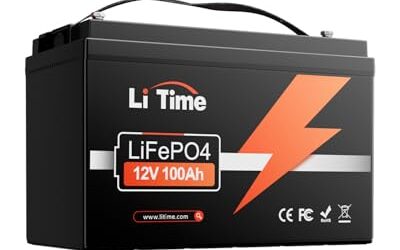
The GREENOE pick is the big-case option. It is listed as a Group 31 battery with 100 amp-hours of capacity at 12.8 volts, a built-in 100-amp battery management system, and a stated figure of 15,000 deep cycles in its listing title. Included components are listed as the battery itself, insulating caps for the bolts, and M8 hardware. Compatible vehicle types in the listing include vans, RVs, trucks, boats, and golf carts, along with solar systems and trailer and backup use in the product title.
Why choose Group 31 if the capacity matches the Group 24 picks? Fit and sturdiness are the honest answers. Some trailers, especially equipment and car-hauler trailers built for a house battery as well as a winch, already carry a Group 31 box. Putting the correct larger case in that box avoids loose packing, improvised hold-downs, and a battery that can shift under braking. A battery that moves in its box is a safety problem first and a reliability problem second, because movement works terminals and cables loose. If your box is Group 31, buy the Group 31 battery. If your box is Group 24, this pick does not belong on your trailer no matter how good a listing looks.
The discharge discussion is unchanged: a stated 100-amp management system defines the winching envelope, and heavy maximum-load pulls belong to a different battery strategy. Within its envelope, this is a sensible house-and-winch battery for a trailer that also powers lights and accessories at the site, with the reserve of a full 100 amp-hour lithium bank that can be drawn deeper than a lead-acid bank of the same label capacity.
The listing notes that a battery discharged too low may need a 14.6-volt lithium iron phosphate adapter with a slow charging function to reactivate it. That detail is worth planning around rather than discovering at a loading site. Keep the battery from sitting deeply discharged, recharge promptly after a winching day, and store it at a partial, maker-recommended state of charge through long idle periods.
How to choose the right trailer winch battery
Start with the winch, not the battery. Find the current draw figures in your winch manual, ideally the draw at the load you actually pull, not just the headline maximum. A rolling vehicle on a shallow ramp asks far less of a winch than a dead, flat-tired vehicle dragged up a steep deck, and honest load estimates keep you out of the commonest trap in this category, which is buying a battery whose protection system cuts out halfway through the hardest pull of the year.
Next, decide the chemistry honestly. Lithium iron phosphate gives you light weight, deep usable capacity, fast recharging with the correct charger, and a long stated cycle life. Its limits are cold charging, which good management systems guard against, and the continuous discharge ceiling of the management system, which is a hard limit rather than a suggestion. Absorbed glass mat deep-cycle batteries tolerate very high short draws without an electronic cutoff, cost less up front in many cases, and shrug off cold charging, but they weigh far more, should not be drawn as deeply, and will need replacement sooner under regular deep cycling. For small and mid-size winches with documented moderate draw, the lithium picks above are the cleaner modern answer. For the heaviest winches, a high-discharge glass mat battery, or a properly engineered multi-battery bank, remains the safer engineering choice, and no article should pretend otherwise.
Then check the physical facts. Group size, terminal position, box hold-down, and cable gauge all decide whether a theoretically correct battery works on your trailer. Winch cables should be the gauge the winch maker specifies for the run, with sound lugs and protected routing. Undersized cable causes voltage drop, which makes a winch pull harder, slower, and hotter on the same battery.
Finally, plan the recharge. A trailer battery that only charges from a tow vehicle seven-pin connection may never reach a full, correct charge, especially with a lithium profile requirement. A dedicated charger matched to the chemistry, used after every winching day and periodically through storage, is what turns a good purchase into years of service.
Wiring and safety notes
Mount the battery in a secured, ventilated box and protect both terminals against contact with tools, chains, and tie-down hardware. Fit a fuse or breaker as the winch maker directs, keep cable runs short, and inspect lugs for heat discoloration after the first hard pulls. Never winch with the battery loose on the deck, and give the winch rest intervals on long pulls. If a management system cuts output during a pull, stop, secure the load so it cannot roll, and solve the sizing problem instead of repeatedly resetting and forcing the pull.
Frequently asked questions
Can I use a starting battery for a trailer winch?
You can in an emergency, and many people have, but it is the wrong tool for regular work. Starting batteries are designed for brief, shallow discharges. Repeated deep winching shortens their life quickly and leaves you with a battery that fades exactly when a load is halfway up the ramps. A deep-cycle battery is built for this pattern of use.
Can the tow vehicle battery run the trailer winch instead?
Long cable runs bring heavy voltage drop, and a winch can strain the vehicle electrical system. A dedicated trailer battery, mounted close to the winch with short, correctly sized cables, is the standard and safer arrangement.
How big a battery does a trailer winch need?
For most light and mid-duty trailer winches, a 100 amp-hour deep-cycle bank is the practical starting point, provided the discharge limit suits the winch. What matters is the combination of capacity, discharge capability, and the number of pulls per session. One short pull of a rolling car and an afternoon of repeated equipment loading are completely different demands on the same label capacity.
How do I store a trailer winch battery over winter?
Recharge it after the last use, store it at the state of charge the maker recommends for that chemistry, keep it somewhere dry, and check it periodically through the season. Lithium batteries in particular should not be charged below freezing, so a charger routine in an unheated space needs a battery with low-temperature protection or a warmer charging location.
Bottom line
For most trailer owners, the Renogy 100Ah lithium battery is the best-documented starting point. The BougeRV is the cold-climate and Group 24 drop-in alternative, the Timeusb presses on stated cycle life and light weight in the same size, and the GREENOE fills a true Group 31 box properly. Whichever you choose, match it to your winch manual first: the best battery is the one whose discharge limit, size, and charging needs fit the winch and trailer you actually own.