Key takeaways
- Compare the best kneeling chairs for back pain, from the DRAGONN by VIVO with a backrest to the rocking Sleekform Austin, with seat height and capacity.
The best kneeling chair for most people with back pain is the DRAGONN by VIVO with a backrest, because it is the only chair in this guide that lets a new kneeling-chair user lean back when the lower back tires, while still holding the open-hip kneeling posture that takes pressure off the lumbar spine, and it adjusts from 21 to 31 inches to fit a standard desk. If the budget is the constraint, the DRAGONN without a backrest is the honest entry point at the same 250-pound rating and the same height range, with brake casters that hold the chair still on hard floors. The Sleekform Austin is the premium rocking pick, with a birchwood rocking base and four-inch molded foam pads that suit longer sessions for people who want movement rather than adjustment, and the Sleekform East Austin adds a backrest to that same rocking frame for buyers who want both. The Flash Furniture Posey is the wooden rolling pick, with a simple X-frame and a seat that adjusts from 20 to 24 inches, for a desk that wants the lightest chair in the guide. One honest note up front: a kneeling chair is office furniture, not a medical device, and no kneeling chair in this guide treats or cures back pain; what the posture does is open the hip angle and shift some of the sitting load from the lower back to the shins, which some people find easier on a sore back and others find hard on the knees. Below, we compare five verified kneeling chairs across seat height, weight capacity, cushion thickness, backrest and base type, so the choice rests on the desk and the body rather than on the chair that looks most ergonomic in a photograph. One scope note: every pick here is a kneeling chair for desk work at a standard home-office desk; none of them is a meditation stool, a cross-legged chair or a saddle seat, and none of them is meant to replace a standard office chair for a full eight-hour day.
As an Amazon Associate, we earn from qualifying purchases.
Table of Contents
- Quick Picks at a Glance
- Quick Comparison
- How to Choose a Kneeling Chair for Back Pain
-
- DRAGONN by VIVO Kneeling Chair with Back Support
-
- Sleekform Austin Kneeling Chair
-
- DRAGONN by VIVO Kneeling Chair
-
- Sleekform East Austin Kneeling Chair with Backrest
-
- Flash Furniture Posey Mobile Wooden Kneeling Chair
- Care and Safety Tips
- Frequently Asked Questions
- Conclusion
- Product and ASIN Reference
Quick Picks at a Glance
- Best overall: DRAGONN by VIVO with Back Support — a 21 to 31 inch height range, a 250-pound rating and a backrest, for a first kneeling chair that still lets the back rest.
- Best rocking pick: Sleekform Austin — a birchwood rocking base and four-inch molded foam pads, for a desk that wants movement rather than adjustment.
- Best budget pick: DRAGONN by VIVO Kneeling Chair — the same 250-pound rating and height range as the backrest model, with brake casters, for the lowest honest entry point.
- Best rocking pick with a backrest: Sleekform East Austin — the Austin rocking frame with a backrest added, for buyers who want both movement and support.
- Best wooden rolling pick: Flash Furniture Posey — a wood X-frame with a seat that adjusts from 20 to 24 inches, for the lightest chair in the guide.
Quick Comparison
| Product | Seat height | Weight capacity | Cushion | Backrest | Base | Tier |
|---|---|---|---|---|---|---|
| DRAGONN by VIVO with Back Support | 21 to 31 in | 250 lb | 3 in foam | Yes | Locking casters | Mid-range |
| Sleekform Austin | 22 in, fixed | 265 lb | 4 in molded foam | No | Rocking birchwood base | Premium |
| DRAGONN by VIVO Kneeling Chair | 21 to 31 in | 250 lb | 3 in foam | No | Brake casters | Budget |
| Sleekform East Austin | 22 in, fixed | 265 lb | 4 in molded foam | Yes | Rocking birchwood base | Premium |
| Flash Furniture Posey | 20 to 24 in | 200 lb | Foam pads | No | Dual-wheel casters | Budget |
How to Choose a Kneeling Chair for Back Pain
Start with seat height, because height is the desk question before it is a comfort question. A kneeling chair sets the seat at an angle, with the shins resting on a lower pad, and the seat height has to leave the forearms level with the keyboard while the knees stay below the desk. The two DRAGONN models adjust from 21 to 31 inches, which is the widest range in the guide and the reason they fit the most desks, while the Flash Furniture Posey adjusts from 20 to 24 inches, which suits a standard desk and a shorter user but leaves less room for a tall desk. The two Sleekform models are fixed at 22 inches, which is the number to check before ordering: a fixed 22-inch seat suits a standard desk of about 28 to 30 inches, and a desk that is much higher or lower will leave the buyer hunching or reaching. Measure the desk first, and treat any chair whose height range is not published as a chair to check on the live page before ordering.
The backrest comes second, because it decides how forgiving the chair is on a bad back day. A kneeling chair without a backrest asks the core to hold the torso upright, which is the point of the posture, but it also means there is nowhere to lean when the lower back tires. The DRAGONN with Back Support and the Sleekform East Austin both carry a backrest, and they are the picks for a first kneeling chair or for a back that flares up, because the backrest turns the chair into a hybrid: kneel while the back feels good, lean back when it does not. The DRAGONN without a backrest, the Sleekform Austin and the Flash Furniture Posey have no backrest at all, which keeps the chair lighter and simpler but asks more of the core. A buyer who has never used a kneeling chair should weigh the backrest heavily, because the chair that lets the back rest is the chair that gets used past the first week.
Cushion thickness comes third, because the shins carry part of the sitting load and thin pads go hard fast. The two Sleekform models carry four-inch molded foam pads, which is the thickest cushioning in the guide and the reason they lead the long-session case, and the separate knee cushions on the Austin make it easier to vary leg position than a single knee pad does. The two DRAGONN models carry three-inch high-density foam on the seat and the knee pad, which is a solid middle ground, and the Flash Furniture Posey carries foam pads on a wood frame that independent review coverage describes as thinner and better suited to light daily use than to long sessions. A buyer who plans to kneel for an hour or more at a stretch should favor the thicker pads, because shin tenderness is the reason most people give up on a kneeling chair, not back pain.
Weight capacity comes fourth, and it is the number that separates the chairs most cleanly. The two Sleekform models are rated to 265 pounds by the maker, which is the highest rating in the guide, and the two DRAGONN models are rated to 250 pounds. The Flash Furniture Posey is rated to 200 pounds, which is the lowest rating here and the reason it sits in the budget tier: it is a light chair for a light user, not a chair for everyone. Check the rating against the user before ordering, and remember that the rating is the maker’s published figure for the frame, not a guarantee of comfort at that weight.
The base comes last, because it decides whether the chair moves with the user or stays put. The DRAGONN models roll on casters with brakes, so the chair can be pulled up to the desk and then locked in place, which suits a hard floor. The Flash Furniture Posey rolls on small dual-wheel casters that do not lock, per independent review coverage of the Posey line, so it moves freely and suits a user who wants to roll away from the desk easily. The two Sleekform models have no casters at all: they sit on a rocking birchwood base that moves with the body instead of across the floor, which suits a user who wants gentle motion while seated and a chair that stays where it is put. None of these is objectively the best base, and the honest question is whether the desk is on a hard floor, a carpet, or a rug, and whether the buyer wants to roll or to rock.
1. DRAGONN by VIVO Kneeling Chair with Back Support

Tier: Mid-range
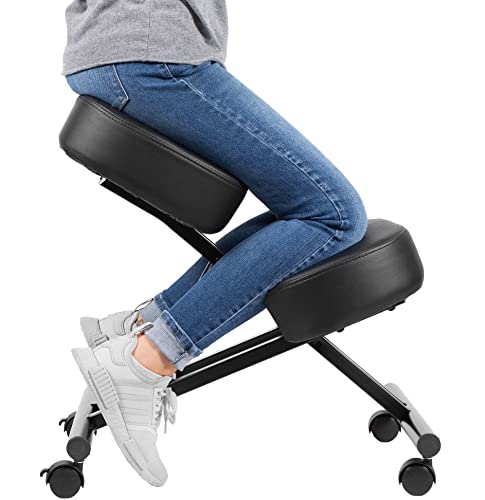
The DRAGONN by VIVO with Back Support is the best overall kneeling chair for back pain because it is the most forgiving chair in the guide. The backrest is the difference: a first-time kneeling-chair user can sit in the open-hip kneeling posture while the back feels good, then lean back when the lower back tires, without getting up and swapping chairs. The seat adjusts from 21 to 31 inches through a manual height pin, which is the widest range in the guide, and the maker rates the chair to 250 pounds. The three-inch high-density foam pads on the seat and the knee rest are thick enough for a real work session, and the locking casters let the chair roll up to the desk and then hold still on a hard floor. The one-year limited manufacturer warranty is the standard backing in this class, and the listing data reviewed carries the identifier for the exact listing pinned in the reference table below.
The published figures back the design up. The listing data reviewed gives the model as the K02B variant, which is the version with the backrest, and the frame as alloy steel with a 21 to 31 inch adjustment range. The seat cushion measures about 16 inches by 12 inches and the knee pad about 17.6 inches by 10 inches, per independent buying-guide coverage of the model, which is a useful pair of numbers because the pad sizes decide whether the shins sit comfortably or hang off the edge. The chair is sold through the maker’s own Amazon store, and independent coverage checked in November 2026 lists it as a current Amazon pick with the backrest fitted. The listing data reviewed carries the identifier for the exact black listing pinned in the reference table below, and the gray and white versions of the same model sell under separate listings.
The qualifications are about the backrest and the pads rather than the frame. A backrest on a kneeling chair is a compromise: it helps on a bad back day, but it also lets the user slump into the backrest and lose the open-hip posture that makes the chair useful in the first place, so the chair works best when the backrest is treated as a rest stop rather than a recliner. The three-inch foam is thinner than the four-inch pads on the two Sleekform models, so a buyer who kneels for long stretches may feel the shins sooner. And the manual height pin means the height is set in steps rather than gliding smoothly, so the buyer should set the height once and leave it. What the money buys is the backrest, the widest height range in the guide, the locking casters and the 250-pound rating, which together make this the chair that asks the least of a first-time user. For a back that needs both the kneeling posture and somewhere to lean, that is a coherent place for it to sit.
Specs
- Seat height: 21 to 31 in, manual height pin
- Weight capacity: 250 lb, per the maker
- Seat cushion: About 16 x 12 in, per independent coverage
- Knee pad: About 17.6 x 10 in, per independent coverage
- Cushion: 3 in high-density foam
- Backrest: Yes
- Frame: Alloy steel
- Casters: Locking dual casters
- Warranty: 1-year limited manufacturer warranty
- Color: Black, per the pinned listing
2. Sleekform Austin Kneeling Chair
Tier: Premium
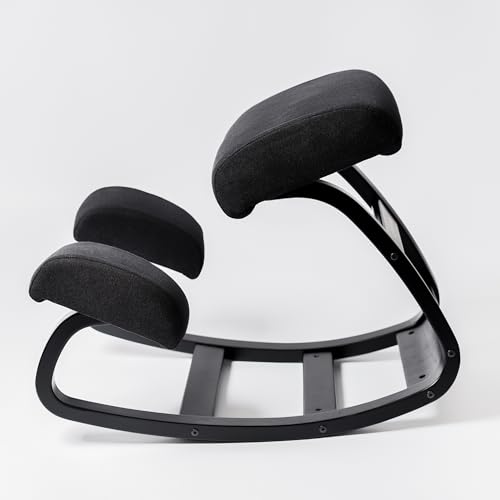
The Sleekform Austin is the best rocking kneeling chair for back pain because it trades adjustment for movement. The birchwood rocking base lets the chair move gently with the body, which suits a user who stiffens up when sitting still, and the four-inch molded foam pads are the thickest cushioning in the guide, which is the reason the Austin leads the long-session case. The seat sits at a fixed 22 inches, and the maker recommends the chair for users from about 5 feet 2 inches to 6 feet 2 inches, with a 265-pound capacity that is the highest rating in the guide. The separate knee cushions make it easier to vary leg position than a single knee pad does, and the maker backs the chair with a one-year warranty and a 90-day money-back guarantee, which is the longest trial window in the guide and the main reason it leads the first-time buyer case among the rocking chairs.
The published figures back the design up. The listing data reviewed gives the dimensions as about 22 inches high by 28 inches long by 21 inches wide, with a fixed seat height of 22 inches and no height adjustment, so the desk measurement matters more here than for any other pick in the guide: a standard desk of about 28 to 30 inches suits the fixed height, and a desk outside that range will leave the buyer hunching or reaching. The frame is birchwood with a rocking base, per the maker and independent coverage, and the cushions are four-inch molded foam with faux leather upholstery. Independent coverage checked in November 2026 confirms the listing is live on Amazon and describes the Austin as the design-focused rocker in the class, and the same coverage notes the 90-day money-back guarantee as the reason to try it first. The listing data reviewed carries the identifier for the exact black listing pinned in the reference table below.
The qualifications are about the fixed height and the missing backrest. There is no height adjustment, so a buyer whose desk does not suit 22 inches has no way to fix it, and the chair should not be bought on the assumption that the desk will adapt. There is no backrest, so the core holds the torso upright for the whole session, which is the point of the posture but also the reason the chair suits shorter sessions than the backrest models. And the rocking base, while gentle, is a base that moves, so the chair belongs on a flat floor rather than a thick rug. What the money buys is the rocking birchwood base, the four-inch molded foam pads, the separate knee cushions, the 265-pound rating and the 90-day trial window, which together make the Austin the chair for a user who wants movement and cushioning rather than adjustment. For a desk that suits 22 inches and a back that likes to move, that is a coherent place for it to sit.
Specs
- Seat height: 22 in, fixed, no adjustment
- Weight capacity: 265 lb, per the maker
- Recommended user height: About 5 ft 2 in to 6 ft 2 in, per the maker
- Dimensions: About 22 x 28 x 21 in, per the listing data reviewed
- Cushion: 4 in molded foam pads, separate knee cushions
- Backrest: No
- Frame: Birchwood rocking base
- Upholstery: Faux leather
- Warranty: 1-year warranty and 90-day money-back guarantee
- Color: Black, per the pinned listing
3. DRAGONN by VIVO Kneeling Chair
Tier: Budget
The DRAGONN by VIVO Kneeling Chair is the best budget kneeling chair for back pain because it keeps the two numbers that matter and drops the backrest. The seat adjusts from 21 to 31 inches through a manual height pin, which is the same widest range in the guide as the backrest model above, and the maker rates the chair to 250 pounds, which is the same rating. The three-inch high-density foam pads on the seat and the knee rest match the backrest model, and the brake casters hold the chair still on hard floors once it is rolled into place. The one-year limited manufacturer warranty is the same backing as the backrest model, and the listing data reviewed carries the identifier for the exact listing pinned in the reference table below.
The published figures back the design up. The listing data reviewed gives the model as the K01B variant, which is the version without a backrest, and the frame as a steel X-frame with a 21 to 31 inch adjustment range. The seat cushion measures about 16 inches by 12 inches and the knee pad about 17.6 inches by 10 inches, per independent buying-guide coverage of the model, which matches the backrest model pad for pad. The chair is sold through the maker’s own Amazon store, and a catalog record dated November 1, 2026 confirms the exact listing and its 250-pound limit. The listing data reviewed carries the identifier for the exact black listing pinned in the reference table below, and the white version of the same model sells under a separate listing.
The qualifications are about the missing backrest and the manual adjustment. There is nowhere to lean when the lower back tires, so the chair asks more of the core than the backrest model, and a buyer who has never used a kneeling chair should plan shorter first sessions and build up. The manual height pin sets the height in steps rather than gliding smoothly, so the height should be set once and left alone. And the three-inch foam is thinner than the four-inch pads on the two Sleekform models, so a buyer who kneels for long stretches may feel the shins sooner. What the money buys is the widest height range in the guide, the 250-pound rating, the brake casters and the same pads as the backrest model, at the lowest honest entry point in the guide. For a back that wants to try the kneeling posture without paying for a backrest, that is a coherent place for it to sit.
Specs
- Seat height: 21 to 31 in, manual height pin
- Weight capacity: 250 lb, per the maker
- Seat cushion: About 16 x 12 in, per independent coverage
- Knee pad: About 17.6 x 10 in, per independent coverage
- Cushion: 3 in high-density foam
- Backrest: No
- Frame: Steel X-frame
- Casters: Brake casters
- Warranty: 1-year limited manufacturer warranty
- Color: Black, per the pinned listing
4. Sleekform East Austin Kneeling Chair with Backrest

Tier: Premium
The Sleekform East Austin is the best rocking kneeling chair with a backrest because it puts the two most forgiving features in the guide on one frame. The birchwood rocking base moves gently with the body, the four-inch molded foam pads are the thickest cushioning in the guide, and the backrest gives the lower back somewhere to lean when it tires, which no other rocking chair in the guide offers. The seat sits at a fixed 22 inches, and the maker rates the chair to 265 pounds, which is the highest rating in the guide, with a one-year warranty and a 90-day money-back guarantee behind it. Independent coverage checked in November 2026 confirms the listing is live on Amazon with stock available, and the listing data reviewed carries the identifier for the exact listing pinned in the reference table below.
The published figures back the design up. The listing data reviewed gives the seat height as 22 inches fixed, with no height adjustment, so the desk measurement matters here just as it does for the Austin: a standard desk of about 28 to 30 inches suits the fixed height, and a desk outside that range will leave the buyer hunching or reaching. The frame is a birchwood rocking base, per the maker and independent coverage, and the cushions are four-inch molded foam with faux leather upholstery, matching the Austin pad for pad. The backrest is the only structural difference from the Austin, and it is the reason the East Austin costs more: it turns a rocking kneeling chair into a chair that can hold the torso upright and then let it rest. The listing data reviewed carries the identifier for the exact listing pinned in the reference table below.
The qualifications are about the fixed height and the price of the combination. There is no height adjustment, so a buyer whose desk does not suit 22 inches has no way to fix it, and the chair should not be bought on the assumption that the desk will adapt. The backrest, while useful, also lets the user slump into it and lose the open-hip posture, so it works best as a rest stop rather than a recliner. And the rocking base belongs on a flat floor rather than a thick rug. What the money buys is the rocking birchwood base, the four-inch molded foam pads, the backrest, the 265-pound rating and the 90-day trial window, which together make the East Austin the most forgiving rocking chair in the guide. For a desk that suits 22 inches and a back that wants both movement and somewhere to lean, that is a coherent place for it to sit.
Specs
- Seat height: 22 in, fixed, no adjustment
- Weight capacity: 265 lb, per the maker
- Cushion: 4 in molded foam pads
- Backrest: Yes
- Frame: Birchwood rocking base
- Upholstery: Faux leather
- Warranty: 1-year warranty and 90-day money-back guarantee
- Stock: In stock, per independent coverage checked in November 2026
5. Flash Furniture Posey Mobile Wooden Kneeling Chair

Tier: Budget
The Flash Furniture Posey is the best wooden rolling kneeling chair for back pain because it is the lightest and simplest chair in the guide. The wood X-frame carries a seat that adjusts from 20 to 24 inches, which suits a standard desk and a shorter user, and the four dual-wheel casters let the chair roll up to the desk and away again without lifting. The foam pads on the seat and the knee rest are thinner than the pads on the other four picks, which is the trade for the light frame and the budget tier, and independent review coverage of the Posey line describes the chair as better suited to light daily use than to long sessions. The maker rates the chair to 200 pounds, which is the lowest rating in the guide, and the one-year limited warranty is the standard backing in this class. The listing data reviewed carries the identifier for the exact gray listing pinned in the reference table below.
The published figures back the design up. The listing data reviewed gives the model as WL-SB-101-GG, a wooden ergonomic kneeling chair in gray fabric, with a seat height of 20 to 24 inches and a weight capacity of 200 pounds. Independent review coverage gives the dimensions as about 17.5 inches wide by 26.5 inches deep by 20 to 24 inches high, and the chair weight as about 18 pounds, which is the lightest chair in the guide by a clear margin. The foam is CA117 fire retardant, per independent coverage of the model family, and the chair is made in Taiwan. The listing data reviewed carries the identifier for the exact listing pinned in the reference table below, and the black version of the same model family sells under a separate listing.
The qualifications are about the capacity, the pads and the casters. The 200-pound rating is the lowest in the guide, so a heavier user should favor one of the 250-pound or 265-pound picks above. The foam pads are thinner than the three-inch and four-inch pads on the other picks, so the shins will feel the chair sooner in a long session. And the dual-wheel casters do not lock, per independent review coverage of the Posey line, so the chair rolls freely and belongs on a flat floor where that movement is wanted. What the money buys is the lightest chair in the guide, a wood frame that suits a home office, a seat that adjusts from 20 to 24 inches, and casters that let the chair roll away from the desk. For a light user who wants a kneeling chair for shorter sessions and a chair that disappears under the desk, that is a coherent place for it to sit.
Specs
- Seat height: 20 to 24 in
- Weight capacity: 200 lb, per the maker
- Dimensions: About 17.5 x 26.5 x 20 to 24 in, per independent coverage
- Chair weight: About 18 lb, per independent coverage
- Cushion: Foam pads, CA117 fire retardant, per independent coverage
- Backrest: No
- Frame: Wood X-frame
- Casters: Dual-wheel casters, do not lock, per independent coverage
- Warranty: 1-year limited warranty
- Color: Gray fabric, per the pinned listing
Care and Safety Tips
A kneeling chair works best as part of a rotation, not as the only seat in the office. Start with short sessions of about twenty to thirty minutes, then stand, stretch and switch back to a standard chair, and build the kneeling time up over a week or two as the shins and the core adapt. The original kneeling-chair manual expressly warns that prolonged use can restrict circulation to the legs, so a chair that felt fine at twenty minutes can still go numb at ninety, and the honest rule is to get up before the legs tingle rather than after. Keep the chair on a flat floor, check the casters or the rocking base for wear every few months, and keep the desk height matched to the seat height so the forearms stay level with the keyboard.
No CPSC recall covers kneeling chairs as a class, and none of the five picks in this guide appears in any recall notice. The recall records below cover conventional office chairs and desks, and each is a different product from the kneeling chairs in this guide. The Veyer WorkPro Momentum office chairs were recalled in January 2025 under CPSC number 25-097, after seven reports that the bolts connecting the back of the chair to its base could come loose, including two minor injuries, and the chairs were sold between October 2021 and September 2024. The HON Gateway office chairs were recalled in June 2020 under CPSC number 20-137, covering about 13,400 chairs whose backs could break, after eleven reports including two minor injuries. The Office Depot Gibson and Biella office chairs were recalled after the seat plate weld cracked or broke, with 153 reports including 25 injuries and a fractured back and hip, covering about 1.4 million chairs sold between 2003 and 2012. Branch ergonomic chairs were recalled under CPSC number 26-735, and Anji Guotai office chairs were recalled in March 2023; both are conventional task chairs, not kneeling chairs. The Realspace Magellan electric desks were recalled in 2019 under CPSC number 19-759, which is a desk recall, not a chair recall. None of these records touches a kneeling chair, and none of them touches any pick in this guide.
A final note on claims: a kneeling chair is office furniture, not a medical device, and no kneeling chair in this guide treats or cures back pain, knee pain or any medical condition. A buyer with a diagnosed back condition, a knee injury, circulation problems or a recent surgery should ask a clinician before buying one, and a buyer who feels knee pain, numbness or tingling while kneeling should stop using the chair and switch back to a standard seat. The chair that helps is the chair that fits the desk, fits the body and gets used in short sessions, and the chair that hurts is the chair that is used too long, at the wrong height, or by a body it was never meant for.
Frequently Asked Questions
Are kneeling chairs good for back pain?
A kneeling chair opens the hip angle and shifts some of the sitting load from the lower back to the shins, which some people find easier on a sore back, but a kneeling chair is office furniture, not a medical device, and it does not treat or cure back pain. The chair helps most when it is used in short sessions alongside a standard chair, and a buyer with a diagnosed back condition should ask a clinician before buying one.
How long should you sit in a kneeling chair each day?
Start with sessions of about twenty to thirty minutes, then stand, stretch and switch to a standard chair, and build the kneeling time up over a week or two as the shins and the core adapt. The original kneeling-chair manual warns that prolonged use can restrict circulation to the legs, so the honest rule is to get up before the legs tingle rather than after, and to treat the kneeling chair as part of a rotation rather than the only seat.
Do kneeling chairs work with a standard desk?
A kneeling chair works with a standard desk of about 28 to 30 inches when the seat height matches it. The two DRAGONN models adjust from 21 to 31 inches and fit the most desks, the Flash Furniture Posey adjusts from 20 to 24 inches, and the two Sleekform models sit at a fixed 22 inches, so a buyer should measure the desk before ordering and favor an adjustable model when the desk height is uncertain.
Can you use a kneeling chair if you have bad knees?
A kneeling chair puts part of the sitting load on the shins and knees, so it is not the right seat for bad knees, and a buyer with a knee injury, circulation problems or a recent surgery should ask a clinician before buying one. The thicker four-inch pads on the two Sleekform models are kinder to the shins than the thinner pads on the other picks, but no kneeling chair removes the load from the knees entirely.
Conclusion
The DRAGONN by VIVO with Back Support is the best kneeling chair for back pain for most buyers, because the backrest makes the first week forgiving, the 21 to 31 inch height range fits the most desks, and the 250-pound rating covers the most users. The DRAGONN without a backrest is the same chair without the backrest, and it is the honest budget pick for a buyer who wants to try the posture without paying for the extra feature. The Sleekform Austin is the premium rocking pick, with the thickest pads in the guide and a 90-day trial window, and the Sleekform East Austin adds a backrest to that same rocking frame for a buyer who wants both movement and support. The Flash Furniture Posey is the lightest chair in the guide, for a light user who wants a kneeling chair for shorter sessions and a chair that rolls away from the desk. Measure the desk, check the weight rating, start with short sessions, and favor the backrest models when the back flares up. The chair that fits the desk and the body is the chair that gets used, and the chair that gets used is the only one that can help.