Key takeaways
- Compare the best oil hoses for fuel transfer, oil cooling and push-lock fuel lines, with sizes, pressure ratings and materials explained for each pick.
An oil hose looks simple — a length of rubber tubing — but the wrong one fails in ways that are messy at best and dangerous at worst. Rubber that is not rated for petroleum softens and swells when it carries diesel, gasoline or engine oil, and a hose built for low-pressure discharge will not hold up on a pressurized oil cooling line. The five hoses in this guide cover the main jobs buyers actually use them for: bulk fuel transfer from a tank or pump, push-lock fuel and oil lines on vehicles and small engines, and a dedicated transmission oil cooler line for tight automotive plumbing.


Every product below is a real listing sold on Amazon US, and every specification in this article comes from that product’s Amazon listing — the inside diameter, length, material, pressure rating and stated intended use. The picks differ mainly by job, so start with the Quick Picks table to find the hose that matches your setup, then read the How to Choose section before ordering. Getting the inside diameter and the pressure rating right matters far more than brand, because a hose that almost fits or almost holds pressure is the one that leaks.
Quick Picks
| Product | Best for | Key spec |
|---|---|---|
| Fill-Rite FRH10020 1″ x 20′ Fuel Transfer Hose with Static Wire | Pump-to-nozzle fuel transfer | 1 inch ID, 20 feet, static wire |
| EVIL ENERGY 1 inch Fuel Transfer Hose 20FT | Farm and bulk fuel dispensing | 150 PSI working pressure, stainless braid |
| EVIL ENERGY 3/8″ Fuel Hose Line Push Lock NBR Rubber SAE 30R7 10FT 300PSI | Push-lock fuel and oil lines | 3/8 inch ID, 300 PSI, SAE 30R7 |
| Jeemiter 3/8″ ID Fuel Hose 25FT Complete Kit | Small engine, auto and marine fuel lines | 25 feet, SAE 30R7, 10 clamps included |
| Hayden Automotive 106 Transmission Oil Cooler Hose | Transmission cooler plumbing | 3/8 inch ID, double cross braided |
How to Choose
Match the hose to the job first
Oil hoses fall into a few distinct jobs, and the construction follows the job. A fuel transfer hose, like the Fill-Rite and the 1 inch EVIL ENERGY below, is a discharge hose: it connects a pump to a nozzle and moves diesel, gasoline, kerosene or petroleum oils out of a tank. It is built wide, flexible and relatively low pressure. A push-lock fuel line, like the 3/8 inch EVIL ENERGY and the Jeemiter kit, feeds a fuel system or an oil cooler on an engine, so it is narrower and rated to a much higher working pressure. The Hayden hose is narrower still in purpose: it exists only to route transmission fluid to and from an add-on transmission cooler. Decide which of those jobs you are doing before comparing anything else, because a transfer hose is the wrong tool for a pressurized engine line no matter how well it is made.
Check the inside diameter and length
Inside diameter decides flow and fit. The two transfer hoses here are 1 inch inside diameter, which suits pump discharge where volume matters more than pressure. The push-lock lines and the cooler hose are 3/8 inch, the common size for automotive fuel lines, oil cooling lines and small engine work. Measure the barb or fitting the hose must push onto; a hose that has to be forced over an oversized fitting will split at the end, and one that slips on loosely will weep fuel. Length matters too: the transfer hoses are 20 feet, enough to reach from a bed-mounted or stationary tank to a vehicle or machine, while the cut-to-fit lines come in 10 feet (EVIL ENERGY push-lock) and 25 feet (Jeemiter), and the Hayden cooler hose is a short 4.5 feet because cooler plumbing runs are short by design.
Read the pressure rating the right way
Listings quote two different numbers and they are not interchangeable. Working pressure is the maximum pressure the hose should see in normal service: 50 PSI for the Fill-Rite transfer hose, 150 PSI for the 1 inch EVIL ENERGY, and 300 PSI for both 3/8 inch push-lock lines. Burst pressure is the point at which the hose fails in testing — 435 PSI on the 1 inch EVIL ENERGY — and it is a safety margin, not a target. Size your choice on working pressure, and leave headroom: a fuel injection or oil cooling circuit that spikes under load should sit comfortably below the hose’s working rating. Transfer and gravity-fed systems run at low pressure, which is why the Fill-Rite’s lower rating is appropriate for its job rather than a weakness.
Material and fluid compatibility
Petroleum fluids attack the wrong rubber, so the inner tube material is the spec to check. Nitrile (NBR) is the standard choice for oil and fuel: the Fill-Rite uses a nitrile inner tube under a neoprene cover, both EVIL ENERGY hoses use nitrile-based construction, and the Jeemiter is NBR rubber. Reinforcement matters as well. The Fill-Rite adds a stainless steel static wire and an internal spring guard — the static wire is a safety feature that drains static charge during fuel dispensing. The 1 inch EVIL ENERGY wraps its nitrile core in a stainless steel braid, and the Hayden cooler hose is double cross braided so it holds its shape around the tight bends of a cooler install. Finally, check the temperature range against your environment: the push-lock EVIL ENERGY is rated from -40°F to 257°F, and the 1 inch EVIL ENERGY from -40°F to 212°F.
The 5 Best Options
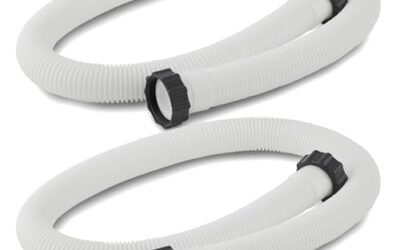
Fill-Rite FRH10020 1″ x 20′ Fuel Transfer Hose with Static Wire
The Fill-Rite FRH10020 is a purpose-built discharge hose for fuel transfer pumps, made to connect a Fill-Rite or similar pump to a nozzle for dispensing diesel, gasoline, kerosene and petroleum oils from tanks and trucks. At 1 inch inside diameter and 20 feet long, it is sized for moving fuel in volume rather than feeding a pressurized line.
Its construction is the reason it leads this guide for transfer work. The nitrile inner tube handles the listed fuels, the neoprene cover stands up to outdoor and shop use, and a stainless steel ground wire runs through the hose to bleed off static — an important detail when you are pumping flammable fuel. An internal spring guard helps protect the hose at the ends where it flexes most.
Specs
- Brand: Fill-Rite
- Model: FRH10020
- Inside diameter: 1 inch
- Length: 20 feet
- Material: Nitrile inner tube, neoprene cover
- Max working pressure: 50 PSI
- Features: Stainless steel static wire, internal spring guard
- Compatible fluids: Diesel, gasoline, kerosene, petroleum oils
Best for: Anyone running a fuel transfer pump on a farm, job site or truck bed who needs a proper discharge hose with static protection.
Watch out for: The 50 PSI working pressure suits pump discharge only. Do not use it as a pressurized engine fuel line or oil line.
EVIL ENERGY 1 inch Fuel Transfer Hose 20FT
The EVIL ENERGY 1 inch Fuel Transfer Hose is the heavy-duty alternative in the transfer category, aimed at farm tanks and bulk dispensing of diesel, gasoline, kerosene and biodiesel. Its listing also names petroleum oils, grease, mineral spirits, B20 biodiesel and ethanol blends among its compatible fluids, which makes it the most flexible choice here on fuel type.
What sets it apart from the Fill-Rite is pressure headroom and reinforcement. It is rated at 150 PSI working pressure with a 435 PSI burst pressure, and the wall is a three-layer build: a nitrile rubber inner layer, a stainless steel braid in the middle, and a PVC and nitrile blended rubber outer layer. The trade-off is stiffness — the listed minimum bending radius is 300mm, so it wants gentle sweeps rather than tight corners.
Specs
- Brand: EVIL ENERGY
- Inside diameter: 1 inch (25mm)
- Outside diameter: 35.5mm
- Length: 20 feet (6m)
- Material: Nitrile rubber inner, stainless steel braid, PVC and nitrile outer
- Working pressure: 150 PSI
- Burst pressure: 435 PSI
- Temperature range: -40°F to 212°F
- Minimum bending radius: 300mm
Best for: Farm and bulk fuel dispensing where the hose sees higher pump pressure or a wider mix of fuels, including biodiesel blends.
Watch out for: The stiff braided wall and 300mm minimum bend radius make it a poor choice for tight routing around obstacles.
EVIL ENERGY 3/8″ Fuel Hose Line Push Lock NBR Rubber SAE 30R7 10FT 300PSI
The EVIL ENERGY 3/8 inch Push Lock hose changes category entirely: this is a line for building fuel systems and oil cooling runs, not for dispensing from a tank. It is a push-lock hose, designed to press onto push-lock fittings without clamps, and its listing states use for fuel systems and oil cooling with diesel, gasoline, biodiesel, oil and grease.
The numbers suit that job. The 3/8 inch bore is the standard size for automotive fuel and oil lines, the working pressure is 300 PSI, and the hose meets the SAE 30R7 standard. The wall is NBR rubber with braided polyester fiber at 3mm thick, described as oil and wear resistant, and the temperature range runs from -40°F to 257°F — the widest top end in this guide, which matters for lines routed near an engine.
Specs
- Brand: EVIL ENERGY
- Inside diameter: 3/8 inch
- Length: 10 feet
- Material: NBR rubber with braided polyester fiber, 3mm wall
- Working pressure: 300 PSI
- Standard: SAE 30R7
- Temperature range: -40°F to 257°F
- Properties: Oil and wear resistant
Best for: Builders plumbing a fuel system or an oil cooler with push-lock fittings who want a rated, standard-compliant line.
Watch out for: Push-lock hose belongs on push-lock fittings. If your setup uses ordinary barbs and clamps, the Jeemiter kit below is the safer match, and 10 feet may be short for a full vehicle re-plumb.
Jeemiter 3/8″ ID Fuel Hose 25FT Complete Kit
The Jeemiter 3/8 inch Fuel Hose Kit is the value pick for general fuel line work across small engines, automobiles and boats. It ships as a complete kit — 25 feet of hose plus 10 clamps — so one purchase covers a full replacement run and the hardware to secure it, and the listing describes it as transporting gas, oil and diesel in fuel systems and oil cooling, with hydraulic fluids also named among its uses.
Like the EVIL ENERGY push-lock, it is NBR rubber rated to the SAE 30R7 standard with a 300 PSI working pressure, and the listing gives a burst figure of 1160 PSI in its product information. The outside diameter is 0.63 inches over the 3/8 inch bore. The extra length is the practical advantage: at 25 feet you can route a line generously, make a mistake, cut it off and still finish the job.
Specs
- Brand: Jeemiter
- Inside diameter: 3/8 inch
- Outside diameter: 0.63 inches
- Length: 25 feet (300 inches)
- Material: NBR rubber
- Working pressure: 300 PSI
- Maximum pressure listed: 1160 PSI (burst)
- Standard: SAE 30R7
- Included components: Fuel hose with 10 clamps
Best for: Small engine, automotive and marine fuel line replacement where you want hose and clamps in one box and plenty of length to work with.
Watch out for: It is a clamp-on line, not a push-lock hose, so it should not be substituted onto push-lock fittings; buy push-lock hose for those.
Hayden Automotive 106 Transmission Oil Cooler Hose
The Hayden Automotive 106 is the specialist in this guide: a hose made for one job, routing transmission fluid to and from an add-on transmission oil cooler in cars and trucks. If you are adding a cooler to protect an automatic transmission while towing or hauling, this is the hose type the cooler kits assume you will use.
It is 3/8 inch inside diameter and 4.5 feet long, which matches the short runs between a transmission, a radiator pass-through and a front-mounted cooler. The construction is double cross braided rubber, and Hayden notes that the design maintains its shape and form under pressure — the practical point being that it resists collapsing or kinking on the tight-radius bends a cooler install forces on it.
Specs
- Brand: Hayden Automotive
- Model: 106
- Item type: Oil cooler hose
- Inside diameter: 3/8 inch
- Length: 4.5 feet
- Material: Rubber
- Construction: Double cross braided, maintains shape under pressure
- Included components: Oil cooler hose
- Color: Black
Best for: Installing or re-plumbing a transmission oil cooler, where short, kink-resistant 3/8 inch hose is exactly what the job needs.
Watch out for: It is a transmission cooler hose, not a general fuel or engine oil line, and at 4.5 feet it only suits short cooler runs.
Which One Fits Your Situation
You dispense fuel from a tank or transfer pump
Pick the Fill-Rite FRH10020 if your pump setup is standard transfer work and you want the safety of a static ground wire. Pick the 1 inch EVIL ENERGY instead if your pump runs harder, your fuels include biodiesel or ethanol blends, or the hose will be dragged around a farmyard and needs the braided, higher-pressure build.
You are plumbing a fuel system or oil cooler on an engine
Pick the EVIL ENERGY push-lock hose if your fittings are push-lock type, and the Jeemiter kit if you are clamping onto barbs — especially on small engines, older vehicles and marine setups where the included clamps and 25 feet of length simplify the job.
You are adding a transmission cooler
Pick the Hayden 106. It is the only hose here designed specifically for transmission cooler plumbing, and its braided, shape-holding build is made for the tight bends that install involves. Buy the length with your routing in mind, because 4.5 feet leaves little spare.
You want one hose that covers the most fluids
The 1 inch EVIL ENERGY lists the broadest fluid range in this guide — diesel, gasoline, kerosene, biodiesel including B20, ethanol blends, petroleum oils, grease and mineral spirits — but remember it is a transfer hose. For engine lines, the two SAE 30R7 hoses are the correct category even though their stated fluid lists are shorter.
Common Mistakes
- Using a fuel transfer hose as a pressurized engine line. Transfer hoses are discharge hoses with modest working pressures; a fuel system or oil cooling circuit needs a rated line like the SAE 30R7 hoses above.
- Sizing by outside diameter or by eye. Fittings seal on the inside diameter — 1 inch and 3/8 inch are the two sizes here, and confusing them guarantees a leak or a split hose end.
- Ignoring fluid compatibility. Ordinary rubber swells and degrades in gasoline, diesel and oil; check that the hose is nitrile or NBR and that your fluid is on its list.
- Forgetting static protection when dispensing fuel. Pumping flammable fuel through a hose without a static wire, like the grounded Fill-Rite, removes a layer of safety the transfer category expects.
- Bending a braided hose too tightly. The 1 inch EVIL ENERGY lists a 300mm minimum bending radius; forcing a tighter bend damages the reinforcement and shortens the hose’s life.
Frequently Asked Questions
Can I use a fuel transfer hose as an engine oil line?
No. A transfer hose such as the Fill-Rite is built for low-pressure discharge from a pump, with a 50 PSI working pressure. An engine oil or fuel line should be a rated hose such as the 3/8 inch SAE 30R7 lines in this guide, which carry a 300 PSI working pressure and are intended for fuel systems and oil cooling.
What does SAE 30R7 mean on a fuel hose?
It is the SAE standard the hose is built to for fuel line service. Both 3/8 inch engine-line hoses in this guide — the EVIL ENERGY push-lock and the Jeemiter kit — are SAE 30R7 rated, which is a useful shorthand that the hose is intended for fuel, oil and diesel lines rather than general-purpose tubing.
What size oil hose do I need?
Match the inside diameter to your fittings and your job. Fuel transfer pumps and nozzles typically use 1 inch hose, as on the Fill-Rite and the 1 inch EVIL ENERGY. Automotive fuel lines, oil cooling lines, small engines and transmission coolers typically use 3/8 inch, as on the EVIL ENERGY push-lock, the Jeemiter kit and the Hayden cooler hose.
Do I need clamps, or should I use push-lock hose?
It depends on your fittings. Push-lock hose, like the EVIL ENERGY 3/8 inch line, is designed to press onto push-lock fittings and hold without clamps. Standard barbed fittings need a clamp-on hose — the Jeemiter kit includes 10 clamps for exactly that setup. Do not mix the two systems.
Related guides
- Best fuel transfer pumps and tank setups
- Best transmission oil coolers for towing
- Best small engine fuel line and clamp kits
As an Amazon Associate, we earn from qualifying purchases.