Key takeaways
- Four fixed-blade broadheads for compound bows by grain weight, cutting diameter, blade design and upkeep, from one-piece steel to replaceable blades.
Picking a fixed broadhead for a compound bow is less about the sharpest-looking head and more about a chain of small matches: the head weight has to suit your arrow build, the cutting diameter has to suit the energy your bow delivers, and the blade design has to suit how much upkeep you accept. Get one link wrong and a strong head groups poorly, penetrates weakly, or dulls after a single pass through ribs.

This roundup is for compound bow hunters choosing between proven fixed designs: whitetail hunters who want a modest cut and deep penetration, elk hunters who want heavier construction, and newer bowhunters buying their first hunting heads. Every pick below is a fixed-blade head whose Amazon listing names compound or vertical bow use, and the details come from the names and specification fields on those listings rather than from maker marketing pages.
Quick Picks
As an Amazon Associate we earn from qualifying purchases.
| Product | Best for | Key spec from title |
|---|---|---|
| G5 Montec 100 Grain | Hunters who resharpen and reuse heads | 1-1/16-inch cut, one-piece steel |
| Muzzy Trocar 100 Grain | Penetration through heavy bone | 1-3/16-inch cut, chisel tip |
| QAD Exodus Full Blade 100 Grain | Field-point-like flight | 1-1/4-inch cut, blades over shaft |
| Slick Trick Magnum 100 Grain | The widest wound channel here | 2-1/4-inch total cut, four blades |
How to Choose
Match the Head Weight to Your Arrow Build
Most compound bows leave the shop set up around 100-grain field points, and the least disruptive choice is a hunting head of the same weight, which keeps your sight picture and arrow spine behaving the way they did on the practice range. All four heads here come in a 100-grain version for exactly that reason. Moving to a heavier head adds front-of-center weight and can help penetration, but it also changes arrow flex and impact point, so treat any weight change as a tuning project with fresh practice sessions, not a swap you make the week before a hunt.
Cutting Diameter Trades Channel Width for Depth
A wider cut opens more tissue and can shorten a blood trail, but every extra fraction of an inch also adds drag the moment the head enters, and that drag comes out of the energy your bow delivered. This group spans the range: the Montec cuts just over an inch, the Trocar and Exodus sit in the middle, and the four-blade Magnum totals two and a quarter inches across both blade pairs. Match the cut to your draw weight and typical shot distance; a modest cut from a lighter setup usually out-penetrates a wide cut that arrives with too little behind it.
One-Piece Steel or Replaceable Blades
Construction decides your upkeep routine. A one-piece head like the Montec has no joints to loosen and can be resharpened on a stone, so a single set can serve for years if you are willing to do the bench work. Replaceable-blade heads such as the Exodus and Magnum trade that permanence for convenience: a dulled or nicked blade comes out and a fresh one goes in minutes before a hunt. Check how the blades are retained before you buy; a positive locking system matters more than blade count, because a blade that shifts in flight ruins the shot.
Flight and Tuning Decide More Than Sharpness
Fixed blades act like small wings at the front of the arrow, so they magnify any tuning flaw that field points forgive. Before judging a head, spin each arrow to confirm it runs true, then group broadheads and field points together at your longest hunting distance. Compact heads with blades swept over the shaft, like the Exodus, usually need the least correction, while wide four-blade heads show form and tuning problems first. Budget practice time for this step; a slightly less sharp head that lands where you aim beats a razor that planes off target.
The 4 Best Options
G5 Montec 100 Grain Broadheads
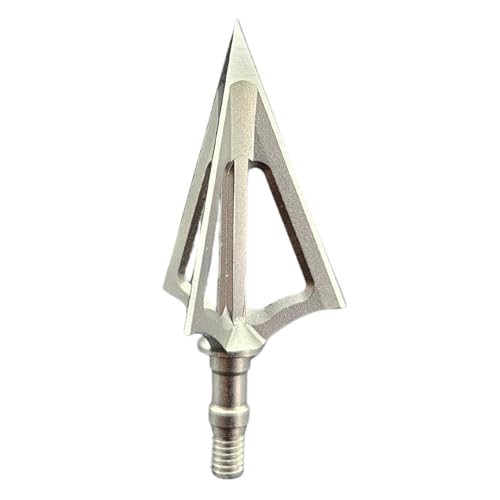
The Montec is the simplest head in this group: a single piece of stainless steel with three fixed blades and nothing to assemble, loosen, or lose in a pack. Hunters who sharpen their own edges tend to land here, because the diamond-cut blades can be worked back on a flat stone after a shot instead of being swapped out. Its modest cutting diameter asks more of shot placement, but in return it keeps momentum on quartering angles and suits lower-poundage compound setups that cannot spare energy on a wide cut.
Specs
- Weight: 100 grain
- Blades: 3 fixed blades
- Cutting diameter: 1-1/16 inch
- Construction: one-piece stainless steel, metal injection molded
- Edges: diamond-cut, resharpenable
- Consistency: spin-checked at the factory
- Pack: 3 broadheads
Best for: hunters who want a single durable head they can resharpen and reuse for years.
Watch out for: the compact cut opens a narrower channel than the wider heads here, so placement matters more.
ASIN: B000IENPWS
Muzzy Trocar 100 Grain Broadheads
The Trocar builds its whole design around the tip: a chisel point on a solid one-piece stainless ferrule, made to keep driving when a blade edge meets rib or shoulder. The three stainless blades sit in a right-helical arrangement, which the listing pairs with a cutting diameter just under an inch and a quarter. It suits hunters who expect contact with bone and would rather have the head hold together and punch through than open the widest possible channel on a clean broadside shot.
Specs
- Weight: 100 grain
- Blades: 3 stainless steel blades, .035 inch thick, right helical
- Cutting diameter: 1-3/16 inch
- Ferrule: solid one-piece stainless steel
- Tip: Trocar chisel tip
- Pack: 3 broadheads
Best for: hunters who expect contact with heavy bone and want a chisel tip that keeps driving.
Watch out for: this is the standard vertical-bow version; the same model name also appears in a crossbow version under a different listing, so check the pack details before ordering.
ASIN: B00AU6D54W
QAD Exodus Full Blade 100 Grain Broadheads
The Exodus takes a different route to accuracy: its blades sweep back over the arrow shaft, so the whole head stays about as short as a field point and catches less air in flight. That compact profile is why it appears in so many discussions about fixed heads that group with practice points. The blades are thicker than most replaceable designs, and when an edge finally dulls you swap the blade set rather than retiring the ferrule, which keeps a tuned arrow flying the same way.
Specs
- Weight: 100 grain
- Blades: 3 fixed blades, .040 inch thick
- Cutting diameter: 1-1/4 inch
- Design: blades extend back over the shaft
- Blade style: full blade
- Blades: replaceable
- Pack: 3 broadheads
Best for: bowhunters whose fixed heads refuse to group with their field points.
Watch out for: choose the Full Blade version listed here; the swept variant is treated as barbed in some states, so check local rules before considering it.
ASIN: B005WMSYBS
Slick Trick Magnum 100 Grain Broadheads
The Magnum runs four blades instead of three, and the geometry adds up: each opposing pair cuts an inch and an eighth, giving a total cut wider than anything else in this roundup. The Lutz stainless blades lock into a steel ferrule with the maker’s Alcatraz system, so there are no tiny screws to work loose in a quiver. It is the pick for a well-powered compound setup hunting deer-sized game, where the bow has energy to spare and a wider channel is worth more than the last bit of penetration.
Specs
- Weight: 100 grain
- Blades: 4 stainless steel Lutz blades, .035 inch thick
- Cutting diameter: 1-1/8 inch per blade pair, 2-1/4 inch total
- Ferrule: Super Steel with Alcatraz blade lock
- Compatibility: compound bows per listing
- Pack: 4 broadheads
Best for: well-powered compound setups hunting deer-sized game, where a wider channel is the priority.
Watch out for: four blades dull faster on practice targets, and the wide cut gives up some penetration on heavy bone.
ASIN: B0076LSQCU
Which One Fits Your Situation
Your First Season Hunting Whitetails
Start with the Montec or the Trocar in 100 grain. Both keep the cut moderate, which suits the draw weights most new bowhunters actually pull, and both hold together if a shot meets shoulder. The Montec asks you to learn sharpening; the Trocar asks you to keep spare blades. Either way, spend your practice time grouping them with field points before the season opens.
Elk, Moose, and Heavy-Boned Game
Favor penetration over channel width. The Trocar’s chisel tip and solid ferrule are built for the rib and shoulder contact that bigger animals present, and the Montec’s one-piece body leaves nothing to bend or separate. Keep total arrow weight up, keep shots at distances where your groups stay tight, and pass on hard quartering angles that ask any head to do too much.
Your Broadheads Group Away From Your Field Points
Before changing heads, check arrow spin and rest timing, because fixed blades expose setup problems that field points hide. If the setup is sound and the groups still wander, the Exodus is the natural next step: its blades sit back over the shaft, the profile stays close to a field point, and it often settles a bow that refuses to group wider heads. Confirm at full hunting distance, not just at twenty yards.
You Shoot a High-Powered Setup at Deer-Sized Game
With energy to spare, the Magnum’s four blades turn that surplus into a wider channel: two crossing cuts that add up to two and a quarter inches. Keep the blades fresh, since a four-blade head dulls on practice foam quickly, and keep a pack of spares in the case. It is the least forgiving head here on a marginal hit through bone, so let shot selection stay conservative.
Common Mistakes
- Mixing head weights in the same quiver, which changes the impact point from arrow to arrow without any visible sign at the bow.
- Practicing all summer with the exact heads you plan to hunt with, then carrying edges dulled by foam into the field.
- Choosing the widest cut on the shelf for a low-poundage bow, then blaming the head when penetration falls short on a rib.
- Skipping the spin check, so a slightly bent ferrule or insert steers every arrow the same wrong way.
- Assuming a head legal in one state is legal everywhere; some states restrict barbed blade profiles and set minimum cutting widths, so check the current rules where you hunt.
Frequently Asked Questions
Are fixed broadheads a better choice than mechanical heads for a compound bow?
Fixed heads have no deployment step, so they suit lower-energy setups, steep angles, and hunters who want the same head to work after passing through ribs. Mechanical heads can fly closer to field points and cut wider, but they depend on blades opening on impact. The four heads here are all fixed designs chosen for compound and vertical bow listings.
Should I pick 100-grain or 125-grain heads?
Match the field points you already practice with, which for most compound setups means 100 grain, and your sights and arrow spine stay valid. A 125-grain head raises front-of-center weight and can add penetration, but it changes arrow flex and impact point, so only move up after re-checking groups and, if needed, arrow spine at the new weight.
Can I practice with the same heads I plan to hunt with?
You can, and shooting the actual heads is the only way to confirm your groups, but foam and dirt dull edges fast. Either dedicate one pack to practice and keep a separate pack untouched for hunting, or plan on resharpening one-piece heads and fitting fresh blades to replaceable designs after your final practice session before the season.
Do these compound bow heads also work on a crossbow?
Not automatically. The picks here are the vertical bow listings for each model; several of these lines also sell dedicated crossbow versions under separate listings, built for the higher speeds and different bolt setups crossbows produce. Match the version to the bow you shoot, and confirm the listing names your bow type before ordering a pack.