Our Short List of 3

- Best for: Hikers who scan wide open ridges and want the broadest view in this group.
- Magnification: 8x
- Objective lens diameter: 30 mm
- Prism type: Roof prism with phase-correction coating
- Prism coating: Dielectric high-reflective multilayer coating
- Best for: Wildlife watchers who want sharp detail and low-light brightness on the trail.
- Magnification: 8x
- Objective lens diameter: 32 mm
- Prism type: Roof prism
- Optical system: HD optics, fully multi-coated

- Best for: Trail birders and nature watchers who want a bright, wide view in a compact body.
- Magnification: 8x
- Objective lens diameter: 32 mm
- Prism type: BaK-4 prisms
- Lens coating: Fully multi-coated
All 4 Picks at a Glance
| Product | Specs | Action |
|---|---|---|
| Nikon PROSTAFF P7 8×30 |
| Check price on Amazon |
| Vortex Diamondback HD 8×32 |
| Check price on Amazon |
| Celestron Nature DX 8×32 |
| Check price on Amazon |
 Bushnell H2O 8×25 |
| Check price on Amazon |
Key takeaways
- Compare four small binoculars for hiking: compact 8x25, 8x30 and 8x32 models with waterproof builds, wide views and light trail-ready bodies.
A hiking binocular has to earn its place in your pack, and that is a harder test than most buyers expect. Every gram counts on a long climb, yet a pair that is too small or too dim turns into dead weight you stop reaching for. The real decision is not which model has the highest magnification on the box. It is how much glass you are willing to carry for the views you actually stop to look at, and whether the pair still works when rain, fog, or a slip on loose rock gets in the way.
This guide is for day hikers, ridge walkers, and trail birders who want a compact pair that rides in a hip-belt pocket or hangs comfortably all day. The four models below were chosen from the names and specifications on their Amazon product pages, with an emphasis on small bodies, waterproof sealing, and a field of view wide enough to follow movement on a hillside.
Quick Picks
As an Amazon Associate we earn from qualifying purchases
| Product | Best for | Key spec from title |
|---|---|---|
| Nikon PROSTAFF P7 8×30 | Wide, bright views on open ridges | 8×30 waterproof roof prism binocular |
| Vortex Diamondback HD 8×32 | Sharp detail on long-distance wildlife | 8×32 HD optics, tripod adaptable |
| Celestron Nature DX 8×32 | Trail birding and nature watching | 8×32 BaK-4 prisms, fully multi-coated |
| Bushnell H2O 8×25 | The lightest carry in a pocket or daypack | 8×25 compact waterproof roof prism |
How to Choose
Magnification and objective size
Eight-power magnification is the sweet spot for hiking because it brings distant ridgelines and birds close without shaking every step out of the image. Ten-power models show more detail, but hand shake grows with them, and on a windy summit that extra shake can erase the advantage. Objective size decides how much light reaches your eyes: a 25 mm lens keeps the body tiny and pocketable, while 30 mm and 32 mm lenses gather more light for dawn starts and shaded forest trails. If you mostly hike in open daylight, a compact 8×25 is enough. If your walks start before sunrise or run through dense canopy, the brighter image of an 8×30 or 8×32 is worth the extra grams.
Field of view and close focus
Field of view tells you how much of a hillside you can scan without moving the binoculars, and on a trail that matters more than raw magnification. A wide view lets you pick up a deer at the treeline or follow a hawk circling overhead without losing it at the edge of the frame. Look for a listed field of view of at least 400 feet at 1,000 yards for comfortable scanning. Close focus matters too, especially on trails rich in butterflies, flowers, and insects. A pair that focuses down to around eight feet lets you study a warbler in a nearby bush or read a trail sign across a clearing without swapping to your eyes alone.
Weight, size, and how it carries
A hiking binocular lives on your chest or in a pocket for hours, so folded size and carry weight decide whether it actually gets used. Roof prism designs fold flatter than porro prism models and slip into a jacket pocket or a hip-belt pouch. Check the listed weight and the folded dimensions before buying, and think about how you will carry it: a neck strap works for short walks, but a harness spreads the load on long days and keeps the pair from swinging while you scramble. Twist-up eyecups and a smooth center focus wheel matter on the trail, because you will adjust them with cold hands or gloves on.
Weather sealing and build
Mountain weather changes fast, and a hiking binocular needs sealing that matches the conditions. Waterproof and fogproof construction, usually achieved with O-ring seals and a nitrogen fill, keeps rain and internal condensation out of the optics. Rubber armor protects the body when the pair knocks against rock or drops onto a trail, and a water-repellent lens coating helps raindrops bead off instead of smearing the view. Fully multi-coated lenses and quality prisms, such as BaK-4 glass with phase correction, keep the image bright and sharp in flat light. If you hike in wet or dusty country, treat sealing as a requirement, not a bonus.
The 4 Best Options
Nikon PROSTAFF P7 8×30
- Best for: Hikers who scan wide open ridges and want the broadest view in this group.
- Magnification: 8x
- Objective lens diameter: 30 mm
- Prism type: Roof prism with phase-correction coating
- Prism coating: Dielectric high-reflective multilayer coating
Hikers who scan wide open ridges and want the broadest view in this group.
Check the fit in your pocket or pouch first, since this is the bulkiest model here.
The Nikon PROSTAFF P7 8×30 is the wide-view pick in this group, and it suits hikers who scan open country where animals and birds appear far off and move fast. Its apparent angle of view is listed at 62.6 degrees, which makes following a soaring raptor or a deer crossing a slope feel natural rather than cramped. The 30 mm objectives gather enough light for early starts, and the locking diopter holds your focus setting so you do not reset it every time the pair comes out of its case. At 17.1 ounces it is no featherweight, but the balance and grip make it comfortable on a harness all day.
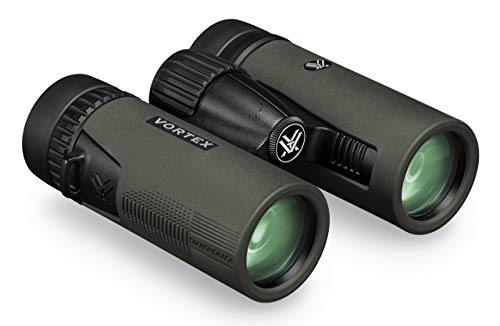
Vortex Diamondback HD 8×32
- Best for: Wildlife watchers who want sharp detail and low-light brightness on the trail.
- Magnification: 8x
- Objective lens diameter: 32 mm
- Prism type: Roof prism
- Optical system: HD optics, fully multi-coated
Wildlife watchers who want sharp detail and low-light brightness on the trail.
Confirm the eyecup position suits you, since eye relief matters most with glasses.
The Vortex Diamondback HD 8×32 is the detail pick, built for hikers who stop to study wildlife at distance and want a crisp image in low light. Its HD optical system and fully multi-coated lenses keep edges sharp across the frame, and the 32 mm objectives pull in more light than the compact 25 mm models when the trail runs through forest shade. The body is tripod adaptable, which helps when you set up at a viewpoint and want a steady look at a distant nest or a herd on a far slope. At 15.9 ounces and 4.4 inches long, it packs small for its brightness.
Celestron Nature DX 8×32
- Best for: Trail birders and nature watchers who want a bright, wide view in a compact body.
- Magnification: 8x
- Objective lens diameter: 32 mm
- Prism type: BaK-4 prisms
- Lens coating: Fully multi-coated
Trail birders and nature watchers who want a bright, wide view in a compact body.
Check the included accessories list, since case and strap contents vary by listing.
The Celestron Nature DX 8×32 is the nature-watching all-rounder, a compact 32 mm pair that balances brightness, weight, and a wide viewing angle. Its BaK-4 prisms and fully multi-coated optics deliver a bright image for its size, and the wide 7.4-degree field of view makes it easy to find birds in a treeline without sweeping back and forth. Phase-coated optics help keep contrast up in the flat light of an overcast day. The rubber-armored body and waterproof, fogproof sealing suit trails where rain arrives without warning, and the compact frame fits a daypack side pocket.
Bushnell H2O 8×25
- Best for: Minimalist hikers who want the smallest, lightest pair that still performs.
- Magnification: 8x
- Objective lens diameter: 25 mm
- Prism type: Roof prism with BaK-4 prisms
- Lens coating: Multi-coated optics
Minimalist hikers who want the smallest, lightest pair that still performs.
The small objectives gather less light, so dawn and dusk views will be dimmer than the 32 mm models.
The Bushnell H2O 8×25 is the lightest carry in this group, and it is the pair for hikers who want binoculars along without noticing them. The 25 mm objectives and roof prism body fold down small enough for a jacket pocket or a hip-belt pouch, so the pair is always within reach when something crosses the trail. BaK-4 prisms and multi-coated optics keep the image clear for a compact model, and the waterproof and fogproof sealing means a rain shower or a stream crossing does not end the viewing. It is the simplest choice here, and that simplicity is its strength on long days.
Which One Fits Your Situation
You hike long distances and count every gram
Pick the Bushnell H2O 8×25. It is the smallest and lightest pair here, and it disappears into a pocket or hip-belt pouch until you need it. The waterproof sealing still handles rain and stream crossings, and 8x magnification is enough to identify birds and check route features ahead. Accept the dimmer low-light view as the trade for a pair you will actually carry on every walk.
You watch birds and wildlife on the trail
Pick the Celestron Nature DX 8×32. Its wide 7.4-degree field of view helps you find birds fast, and the BaK-4 prisms with fully multi-coated optics keep the image bright in forest shade. The 32 mm objectives give it an edge over the compact 25 mm model when light fades, while the body stays small enough for a daypack pocket.
You scan open ridges and mountain slopes
Pick the Nikon PROSTAFF P7 8×30. Its 62.6-degree apparent angle of view is the widest in this group, so tracking a moving animal across a hillside feels easy and natural. The locking diopter holds your setting between stops, and the oil and water-repellent coating keeps the view clear when weather turns on an exposed ridge.
You want the sharpest image for distant detail
Pick the Vortex Diamondback HD 8×32. Its HD optical system delivers crisp detail at distance, and the tripod-adaptable body lets you steady the view at a viewpoint for a long, unhurried look. The 16 mm eye relief also makes it a comfortable choice if you wear glasses on the trail.
Common Mistakes
- Choosing 10x or 12x magnification for hiking, then fighting hand shake on every stop.
- Buying a full-size 42 mm pair for a long trail and leaving it in the car because it is too heavy to carry.
- Ignoring field of view, then losing moving animals at the edge of a narrow image.
- Skipping waterproof and fogproof sealing, then watching the lenses fog up on a cold morning climb.
- Forgetting to check close focus distance before buying a pair for nearby birds, butterflies, and flowers.
Frequently Asked Questions
What magnification is best for hiking binoculars?
Eight-power magnification is the best all-round choice for hiking. It brings distant subjects close enough to identify while keeping hand shake low and the field of view wide. Higher magnification shows more detail but shakes more and narrows the view, which makes it harder to find and follow animals on a hillside.
Are 8×25 binoculars bright enough for hiking?
Yes, for most daylight hiking an 8×25 pair is bright enough, and its small size means you will carry it more often. The trade is low-light performance: at dawn, dusk, or in deep forest, a 25 mm objective gathers less light than a 30 mm or 32 mm model, so the image looks dimmer when the light fades.
Do hiking binoculars need to be waterproof?
Yes, waterproof and fogproof sealing is worth having on any hiking pair. Trails bring rain, river crossings, sweat, and big temperature swings between valley and summit, and sealed, nitrogen-filled binoculars keep moisture out of the optics so the view stays clear in those conditions.
How much should hiking binoculars weigh?
Aim for under 18 ounces for a pair you will carry all day, and under 12 ounces if you want a true pocket model. The pairs in this guide run from a compact 8×25 to 17.1 ounces for the Nikon 8×30, so think about whether you carry on a neck strap, a harness, or in a pocket before choosing.