
Key takeaways
- Pro: A portable playard suits families who visit grandparents, because it can come along and set up quickly in a spare room.
- Pro: A mainstream brand means replacement sheets, pads, and accessories are easy to find in most stores.
- Con: Portable playards have limited floor space, so older crawlers will outgrow the room to move relatively quickly.
Every parent eventually reaches the same moment: the baby is mobile, the phone is ringing, dinner is on the stove, and the living room floor is no longer a safe place to leave a crawler alone for two minutes. A playpen gives a defined, contained area where a child can sit, roll, and explore while you step away within sight. The question is which kind fits your home, your travel habits, and the age of your child.
There are two main families. Portable playards have mesh sides and fold for travel, while freestanding play yards use panels you arrange into a fenced area. This guide compares six well-known options across both, explains four buying rules that are easy to check against safety standards, and spells out who each suits. As of 2026, look for a JPMA certification or compliance with current federal playard safety rules, and never add extra mattresses or pillows to a playard.
Quick Picks
| Product | Best for | Worth knowing |
|---|---|---|
| Graco Pack ‘n Play On the Go Playard | Travel and grandparent visits | On the Go points to a portable, foldable format |
| Regalo 192-Inch Super Wide Adjustable Baby Gate and Play Yard | Large open living areas | 192 inches indicates a long panel set that can fence a big zone |
| Summer Pop ‘n Jump Portable Playard | Quick setup between rooms | Portable playard in the name |
| Joovy Room2 Portable Playard | Families wanting a playard from a nursery-gear brand | Room2 in the name hints at a two-purpose design |
| Cosco Funsport Play Yard | Simple, basic play space | Play yard format named outright |
| Hiccapop PlayPod Playpen | Indoor and outdoor play zone | Playpen format stated in the name |
How to Choose
Playard versus play yard
A playard has fixed mesh walls, a floor, and often a folding frame, so it travels and can double as a sleep space with the proper mattress pad. A play yard uses separate panels that connect into a shape, offering more floor space for older crawlers. Rule of thumb: choose a playard for newborns to early crawlers and a panel-style yard for mobile babies who need room to move.
Size, floor area, and room fit
Measure the space you plan to use and check the product’s footprint. Compact playards are about 28 by 40 inches, which is cozy for a single infant. Panel play yards commonly span 6 to 16 feet of perimeter. Remember the child needs space to stand and move, and you need room to lean in comfortably without stepping around furniture.
Safety standards and mesh details
Mesh openings should be small enough that fingers and buttons cannot catch, and top rails must lock firmly to prevent collapse. Look for compliance with the current federal safety standard for play yards, plus JPMA seals when offered. Never use a damaged playard, and discard any with torn mesh or loose hardware. Follow the weight and height limits that the maker states on the label. Check the latch with your own hands too: a top rail that clicks firmly into place and resists a hard tug is a sign of a well-built folding mechanism, while a loose one deserves a return.
Portability, setup, and cleaning
Fold, weight, and carry bag details matter if you travel. Count the steps to set up and take down, and test it in a store when possible. Removable, machine-washable covers are far easier to keep clean than stained fixed fabric. If you plan to use a play yard outdoors, look for wipe-clean surfaces and a base that does not let the panels slide on grass.
Our Picks Reviewed
Graco Pack ‘n Play On the Go Playard
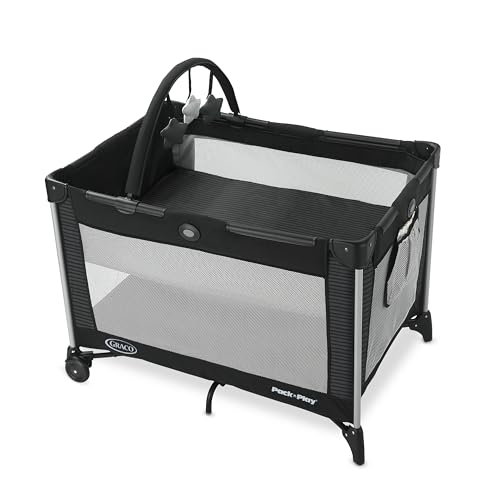
Graco On the Go Pack 'n Play Playard, Kaden | Playard & Full-Size Infant Bassinet, Quick Push-Button Set-Up, Easy, Compact Fold, Safe Sleep Design, Travel-Ready




As an Amazon Associate we earn from qualifying purchases. Product prices and availability are accurate as of the date/time indicated.
Graco is a widely known baby gear brand, and the Pack ‘n Play On the Go name points to a portable playard that folds for travel.
- Pro: A portable playard suits families who visit grandparents, because it can come along and set up quickly in a spare room.
- Pro: A mainstream brand means replacement sheets, pads, and accessories are easy to find in most stores.
- Con: Portable playards have limited floor space, so older crawlers will outgrow the room to move relatively quickly.
Skip it if you want a big, open play area for a mobile child who is already pulling up and cruising. Families with a large open living room may also prefer a panel-style yard that grows with the baby and covers more floor. It also makes less sense for a household with a toddler who already climbs, since low mesh walls are easy to scale.
Regalo 192-Inch Super Wide Adjustable Baby Gate and Play Yard

Regalo 24"-192" Super Wide Metal Baby Gate & Play Yard, 2-in-1, Black | Adjustable Extra Wide Playpen & Dog Gate for Babies, Toddlers & Pets, Doorways & Open Spaces, Baby Safety Alliance Certified


As an Amazon Associate we earn from qualifying purchases. Product prices and availability are accurate as of the date/time indicated.
Regalo sells baby safety products, and this item doubles as a long gate and a play yard, with 192 inches of adjustable length stated in the name.
- Pro: A very long panel set can enclose a large corner of a living room, giving a mobile baby much more space than a small playard.
- Pro: Dual use as a gate and a play yard lets you reconfigure it as your child grows or as your needs change.
- Con: Panel yards usually do not fold as compactly as a portable playard, so they are awkward for travel.
Skip it if you have a small apartment or need something you can pack in a car trunk. Anyone who wants a fully enclosed floor for a very young infant should also look for a playard with a built-in bottom, since gaps along a floor edge are not suitable for the smallest babies.
Summer Pop ‘n Jump Portable Playard

Summer Infant Pop ‘N Play Deluxe Ultimate Playard, Aqua Splash - Full Coverage Indoor/Outdoor Portable Play Pen with Fast, Easy and Compact Fold


As an Amazon Associate we earn from qualifying purchases. Product prices and availability are accurate as of the date/time indicated.
Summer makes baby gear, and the Pop ‘n Jump name suggests a quick, pop-up style setup in a portable playard.
- Pro: A pop-up design can reduce the fuss of setup, which is a plus for parents who move the playard between rooms.
- Pro: Portable construction makes it useful for a day trip, a visit to a friend’s home, or a second location in the house.
- Con: Quick-fold designs may have a smaller play surface, so it works better for infants than for toddlers on the move.
Skip it if you want a permanent, spacious play zone in the main living room. A baby who is already standing and bouncing against the sides may also outgrow a compact design faster than you expect, so consider a larger yard instead. Parents of two children close in age will likely feel the pinch of a small floor sooner still.
Joovy Room2 Portable Playard
Joovy is a nursery gear brand, and the Room2 name hints at a two-in-one approach in a portable playard.
- Pro: A brand focused on nursery gear often invests in thoughtful details like carry bags and sturdy frames.
- Pro: Portable playard format means you can use it for naps, travel, and short play sessions at home.
- Con: Specialty nursery brands can cost more than mainstream playards, which stretches the budget for a product used for a short time.
Skip it if you only need a simple play space for a short season of use. Parents who do not travel and who have lots of floor space may prefer an adjustable panel yard that offers more room for the same period. Anyone who simply wants the cheapest option that meets safety rules should compare a no-frills model first.
Cosco Funsport Play Yard
Cosco sells value-focused baby gear, and the Funsport name points to a basic play yard intended for everyday use.
- Pro: A basic play yard keeps things simple, with fewer parts to assemble or lose.
- Pro: Value-focused brands often make a play space reachable for families watching expenses.
- Con: Basic designs may lack extras like toy bars, canopies, or storage pockets that other playards include.
Skip it if you want a feature-rich playard with changing tables, canopies, or other add-ons that make daily routines easier. Parents who travel often should also confirm how compactly it folds, because basic models can be bulkier than travel-focused ones and harder to wrestle into a small trunk alongside luggage and a stroller. Do not treat a basic yard as a substitute for a proper crib.
Hiccapop PlayPod Playpen
Hiccapop makes baby play products, and the PlayPod name points to a playpen designed for flexible use in different spaces.
- Pro: A playpen that can move between rooms gives a parent a flexible play zone in whichever area they are working.
- Pro: Panel-style construction allows larger floor space than compact portable playards.
- Con: A larger footprint takes more room to store and may need a flat, even surface to stay steady.
Skip it if you are tight on space or want a unit that folds into a small bag for travel. Families with curious pets should also check that the panels cannot be easily pushed over before leaving a child unattended. Anyone who plans to use it on a deck or lawn should confirm the maker approves outdoor use and that the ground is level.
Which One Fits
- Travel and grandparent visits: Graco Pack ‘n Play On the Go or Summer Pop ‘n Jump.
- Big living room with a mobile baby: Regalo 192-Inch Super Wide Play Yard or Hiccapop PlayPod.
- Nursery-gear fans who value details: Joovy Room2.
- Simple, low-fuss everyday setup: Cosco Funsport Play Yard.
- Twins or a baby plus a toddler: choose the roomiest panel yard and set it up where you can see both children.
- Small apartment with little floor to spare: a compact playard that folds away after naptime beats a permanent fence in the middle of the room.
- Parents who work from home: a lightweight option that can slide between the office and the kitchen keeps the baby close without a daily struggle.
Common Mistakes
- Adding extra mattresses, pillows, or bumpers inside a playard.
- Leaving a baby unattended for long periods in any playpen.
- Ignoring the manufacturer’s weight and height limits.
- Using a damaged playard with torn mesh or loose hardware.
- Placing the playpen near cords, blinds, or hot surfaces.
FAQ
At what age can a baby use a playpen?
Many playards can be used from birth for supervised play or sleep when the manufacturer allows it, and are outgrown when a child can climb out or exceeds the weight limit.
Can a playard replace a crib?
Some are designed for sleep, but they are intended mainly for travel or short-term use. Always follow the maker’s instructions.
Where should I place a playpen?
In a room where you can see the baby, away from windows, cords, and kitchen hazards.
What other nursery gear helps with play and learning?
A child-sized art space works well later, so see our kids art table guide. Cleaner floors also help, as covered in our bagless stick vacuum roundup.
How do I clean a playpen?
Wipe mesh and plastic with mild soap and water, and wash removable covers according to the label.


