Key takeaways
- Compare the best tablet stands for desks, from the classic Lamicall to the height-adjustable LISEN, with size fit, materials, stability, and portability.
The best tablet stand for most desks is the classic Lamicall adjustable stand, because it is a single piece of bent aluminum with a wide base and a deep hook that holds tablets from 4 to 13 inches in either orientation, and it does the one job a desk stand has to do, which is to hold the screen still at a readable angle while the hands stay free for a keyboard, a notebook or a coffee. If the tablet is a large one, the OMOTON T1 is the honest budget pick, with longer support arms and a hollow frame that keeps a 12.9-inch tablet from sagging forward, and it costs less than the aluminum stands around it while still being aluminum itself. The UGREEN stand is the value pick for a desk that wants a heavier base, with a thicker foot and a foldable frame that packs flat when the tablet goes back in a bag. The LISEN stand is the premium pick for a desk that wants height rather than just angle, because its three-stage folding frame raises the screen to about 7.3 inches and rotates a full circle, which suits video calls and second-screen work better than a fixed cradle. The second Lamicall in the guide, the foldable rotating model with the heavy base, is the premium pick for a desk that wants the stand to disappear when it is not in use, because it folds slim and still rotates. One honest note up front: two of the five picks are Lamicall stands, in different forms, because Lamicall sells the two most distinct shapes in the class, a fixed-angle cradle and a foldable rotating riser, and no other maker in the class offers both shapes at the same level of listing history; the guide keeps both because they solve different desk problems, not because the brand needed two slots. Below, we compare five verified tablet stands across size fit, material, adjustment range, base stability and portability, so the choice rests on the tablet and the desk rather than on the stand that looks most sculptural in a photograph. One scope note: every pick here is a passive desktop stand, with no battery, no motor and no charging port; none of them is a floor stand, a gooseneck clamp mount or a pillow stand, and none of them is meant to hold a laptop, which is a different weight class and needs a laptop stand.
As an Amazon Associate, we earn from qualifying purchases.
Table of Contents
- Quick Picks at a Glance
- Quick Comparison
- How to Choose a Tablet Stand for Desks
-
- Lamicall Adjustable Tablet Stand
-
- OMOTON T1 Tablet Stand
-
- UGREEN Tablet Stand
-
- LISEN Tablet Stand
-
- Lamicall Adjustable iPad Stand with Rotating Base
- Care and Safety Tips
- Frequently Asked Questions
- Conclusion
- Product and ASIN Reference
Quick Picks at a Glance
- Best overall: Lamicall Adjustable Tablet Stand — a wide aluminum base and a deep hook that holds 4 to 13 inch tablets in either orientation, for a desk that wants the screen still and the hands free.
- Best for large tablets: OMOTON T1 Tablet Stand — longer support arms and a hollow frame that keeps a large tablet from sagging forward, for the lowest honest entry point in the guide.
- Best aluminum value: UGREEN Tablet Stand — a thicker base and a foldable aluminum frame, for a desk that wants more weight under the tablet without paying the premium tier.
- Best height-adjustable: LISEN Tablet Stand — a three-stage folding frame that raises the screen to about 7.3 inches and rotates a full circle, for video calls and second-screen work.
- Best foldable: Lamicall Adjustable iPad Stand with Rotating Base — an ultra-slim folding frame with a heavy metal base, for a desk that wants the stand to disappear when it is not in use.
Quick Comparison
| Product | Max tablet size | Material | Adjustment | Foldable | Tier |
|---|---|---|---|---|---|
| Lamicall Adjustable Tablet Stand | 13 in | Aluminum | Angle | No | Mid-range |
| OMOTON T1 Tablet Stand | 13 in | Aluminum | Angle | No | Budget |
| UGREEN Tablet Stand | 13 in | Aluminum | Angle | Yes | Mid-range |
| LISEN Tablet Stand | 12.9 in | Aluminum | Height and angle, 360-degree rotation | Yes | Premium |
| Lamicall Adjustable iPad Stand with Rotating Base | 13 in | Metal | Angle and height, 360-degree rotation | Yes | Premium |
How to Choose a Tablet Stand for Desks
Start with size fit, because a stand that cannot hold the tablet is not a stand at all. Four of the five picks in this guide accept tablets up to 13 inches, which covers the largest mainstream tablets, and the LISEN accepts up to 12.9 inches, which covers the same tablets except for a 13-inch model in a thick case. The number to check before ordering is the tablet plus its case: a slim case adds almost nothing, but a rugged case with a thick back and a built-in hand strap can add enough depth that the tablet no longer sits in the hook, and the hook depth is the dimension that decides it. Measure the tablet with the case on, and treat any stand whose maximum size is not published as a stand to check on the live page before ordering.
Stability comes second, because a stand that tips when the screen is tapped is worse than no stand at all. The base is the stability question before it is a looks question. A wide, heavy base holds the tablet still when a finger taps the top of the screen, and a narrow, light base lets the whole assembly rock forward. The UGREEN stand carries a thicker base than the other fixed-angle stands in the guide, which is the reason it leads the value case, and the Lamicall rotating model carries a heavy metal base, which is the reason it can rotate without walking across the desk. Rubber pads on the base and on the hook matter as much as weight, because they keep the stand from sliding on a smooth desk and keep the tablet from slipping in the cradle. A buyer who taps the screen hard, or who uses the tablet for drawing with a stylus, should favor the wider bases, because tapping is a sideways force and a narrow base has no answer to it.
Adjustment comes third, and it splits the guide into two camps. The fixed-angle stands, the classic Lamicall, the OMOTON T1 and the UGREEN, adjust the viewing angle and nothing else: the tablet sits at one height, and the angle is the only thing that changes. The height-adjustable stands, the LISEN and the Lamicall rotating model, raise the screen as well as tilting it, which matters when the tablet is a second screen beside a monitor or a camera for video calls, because a screen at desk level forces the neck down and a screen at eye level does not. The LISEN raises the screen to about 7.3 inches, which is the tallest lift in the guide, and the Lamicall rotating model raises it less but adds a 360-degree rotating base, which suits a desk where the tablet turns to face a second person. A buyer who only watches video should favor the fixed-angle stands, because they are simpler and cheaper, and a buyer who works on the tablet should favor the height-adjustable stands, because height is the ergonomic question and angle alone cannot answer it.
Material comes fourth, and it is the number that separates the stands most cleanly after size. All five picks in this guide are metal, which is the honest baseline for a desk stand: metal does not flex under a large tablet, it does not creep out of shape over a summer, and it survives being knocked off the desk. The difference inside the metal class is the finish and the thickness. The classic Lamicall and the OMOTON T1 are single-piece aluminum cradles, which is the simplest construction in the guide and the reason they are the most durable shapes here. The UGREEN and the LISEN are folding aluminum frames, which trade some rigidity for portability, and the Lamicall rotating model is a heavier metal base with a folding neck, which trades portability for rotation. A buyer who wants the stand to last for years should favor the single-piece cradles, because there are no hinges to loosen, and a buyer who travels with the stand should favor the folding frames, because a cradle does not pack flat.
Portability comes last, because it decides whether the stand lives on the desk or in a bag. The folding stands in the guide, the UGREEN, the LISEN and the Lamicall rotating model, collapse flat enough to slip into a laptop bag, which suits a desk that is shared or a tablet that travels. The fixed cradles, the classic Lamicall and the OMOTON T1, do not fold, which suits a desk where the stand stays put and the tablet comes and goes. None of these is objectively the best shape, and the honest question is whether the stand moves with the tablet or stays with the desk, and whether the buyer wants to pay for hinges and rotation or for a single piece of metal that never loosens.
1. Lamicall Adjustable Tablet Stand
Tier: Mid-range
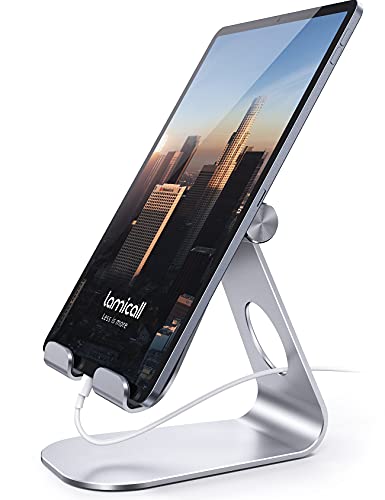
The Lamicall Adjustable Tablet Stand is the best overall tablet stand for desks because it is the simplest shape in the guide executed with the widest base. The stand is a single piece of aluminum bent into a cradle with a deep hook, and the tablet rests in the hook at an angle the user sets by sliding it along the base, which means there are no hinges to loosen and no joints to wear out. It accepts tablets from 4 to 13 inches, which covers everything from a small e-reader to the largest mainstream tablet, and it holds the tablet in portrait or landscape without any adjustment, because the hook is deep enough to catch the bottom edge in either orientation. The base measures about 5 inches by 5.5 inches, which is the widest footprint among the fixed cradles in the guide, and the rubber pads on the base and the hook keep the stand from sliding on a smooth desk and keep the tablet from scratching. The listing data reviewed carries the identifier for the exact silver listing pinned in the reference table below.
The published figures back the design up. The listing data reviewed gives the dimensions as about 5 inches by 5.5 inches by 4.5 inches, with a weight of about 8.8 ounces for the silver version, which is light enough to move around the desk and heavy enough, with the wide base, to hold a large tablet still when the screen is tapped. The stand is aluminum throughout, per the maker and the listing data, with a hook that leaves a gap for a charging cable, so the tablet can charge while it stands, which matters for a tablet that serves as a second screen all day. Independent coverage of the class names this stand the most established desktop tablet stand on the market, and the listing data reviewed shows it as a current Amazon listing with the silver version as the long-running one. The listing data reviewed carries the identifier for the exact silver listing pinned in the reference table below, and other colors of the same model sell under separate listings.
The qualifications are about the fixed height and the open back. There is no height adjustment, so the tablet sits at desk level and the neck looks down, which suits watching video and following a recipe but not a full day of second-screen work, and a buyer who wants the screen at eye level should favor one of the height-adjustable picks below. The back of the stand is open, which is good for airflow and for cable access but means the tablet is held only by the hook and the lean, so a tablet in a very thick rugged case may sit proud of the hook and feel less secure. And the angle is set by sliding the tablet along the base rather than by a locking hinge, so the angle is infinitely adjustable but not locked, and a hard tap near the top of a large tablet can shift it. What the money buys is the widest base among the fixed cradles, a single piece of aluminum with nothing to loosen, a hook deep enough for portrait and landscape, and the longest listing history in the guide. For a desk that wants the screen still and the hands free, that is a coherent place for it to sit.
Specs
- Max tablet size: 13 in, per the listing data reviewed
- Min tablet size: 4 in, per the listing data reviewed
- Dimensions: About 5 x 5.5 x 4.5 in, per the listing data reviewed
- Weight: About 8.8 oz, silver version, per the listing data reviewed
- Material: Aluminum
- Adjustment: Angle, by sliding the tablet along the base
- Orientation: Portrait and landscape
- Charging access: Open hook gap for a charging cable
- Pads: Rubber pads on base and hook
- Color: Silver, per the pinned listing
2. OMOTON T1 Tablet Stand

Tier: Budget
The OMOTON T1 Tablet Stand is the best tablet stand for large tablets on a budget because it puts the money into longer support arms instead of into a heavier base. The stand is a single piece of aluminum with two long arms that reach further up the back of the tablet than the arms on the other fixed cradles in the guide, which is the reason a 12.9-inch tablet sits in it without sagging forward, and the hollow frame keeps the weight down while leaving the back of the tablet open to the air. It accepts tablets up to 13 inches, which covers the largest mainstream tablets, and it holds them in portrait or landscape, because the arms are long enough to catch the tablet in either orientation. The base measures about 4.92 inches by 5.51 inches, which is a solid footprint for the class, and the rubber pads on the base and the arms keep the stand from sliding and the tablet from scratching. The listing data reviewed carries the identifier for the exact gray listing pinned in the reference table below.
The published figures back the design up. The listing data reviewed gives the dimensions as about 4.92 inches by 5.51 inches by 4.61 inches, with an aluminum frame throughout, per the maker and the listing data, and the hollow design is the feature the maker leads with, because it lets air reach the back of a tablet that runs warm during video calls. Independent coverage of the class names the T1 the pick for large tablets, because the longer arms are the difference between a tablet that leans and a tablet that stands, and a retail record dated November 2026 shows the stand in stock and fulfilled through Amazon. The listing data reviewed carries the identifier for the exact gray listing pinned in the reference table below, and other colors of the same model sell under separate listings, which is worth noting because one colorway listing has shown an empty offer record in crawls, so the gray listing is the one to pin.
The qualifications are about the fixed height and the light frame. There is no height adjustment, so the tablet sits at desk level, which suits watching video and reading but not a full day of second-screen work, and a buyer who wants the screen raised should favor the LISEN or the Lamicall rotating model below. The hollow frame is lighter than a solid base, which is good for moving the stand around the desk but means the stand relies on its footprint rather than its weight to stay put, so a hard tap near the top of a large tablet can rock it. And the arms, while longer than the arms on the other fixed cradles, are still fixed arms, so a tablet in a very thick case may sit less deep in the cradle than a bare tablet does. What the money buys is the longest support arms among the budget stands, an aluminum frame that does not flex under a large tablet, a hollow back that keeps the tablet cool, and the lowest honest entry point in the guide. For a desk with a large tablet and a small budget, that is a coherent place for it to sit.
Specs
- Max tablet size: 13 in, per the listing data reviewed
- Dimensions: About 4.92 x 5.51 x 4.61 in, per the listing data reviewed
- Material: Aluminum
- Adjustment: Angle
- Orientation: Portrait and landscape
- Support arms: Longer arms for large tablets, per the maker
- Frame: Hollow design for airflow, per the maker
- Pads: Rubber pads on base and arms
- Color: Gray, per the pinned listing
3. UGREEN Tablet Stand

Tier: Mid-range
The UGREEN Tablet Stand is the best aluminum value tablet stand for desks because it carries a thicker base than the other fixed-angle stands in the guide and still folds flat. The stand is aluminum throughout, with a foot that is visibly thicker than the foot on the classic Lamicall or the OMOTON T1, which is the reason it holds a large tablet still when the screen is tapped, and the frame folds down to a flat slab that slips into a laptop bag, which suits a desk that is shared or a tablet that travels. It accepts tablets from 4 to 13 inches, which covers the largest mainstream tablets, and it holds them in portrait or landscape, because the hook is wide enough to catch the bottom edge in either orientation. The dimensions run about 7.2 inches by 4.72 inches by 6.98 inches when open, which is the tallest open frame among the fixed-angle stands in the guide, and the thicker base is the weight that keeps that taller frame from rocking. The listing data reviewed carries the identifier for the exact black listing pinned in the reference table below.
The published figures back the design up. The listing data reviewed gives the model as the thicker-base aluminum version, with a foldable frame and an adjustable angle, per the maker and the listing data, and the stand is sold through the maker’s own Amazon store. Independent coverage of the class names the UGREEN stand the value pick for a desk that wants a heavier base without paying the premium tier, and the listing data reviewed shows it as a current Amazon listing. The listing data reviewed carries the identifier for the exact black listing pinned in the reference table below, and other colors of the same model sell under separate listings.
The qualifications are about the hinges and the fixed height. The folding frame has hinges, which is the price of portability, and hinges are the one part of a stand that can loosen over time, so the stand should be folded and unfolded gently rather than snapped open, and a buyer who never moves the stand should favor one of the single-piece cradles above. There is no height adjustment beyond the angle, so the tablet sits at desk level, which suits watching video and reading but not a full day of second-screen work, and a buyer who wants the screen raised should favor the LISEN or the Lamicall rotating model below. And the taller open frame means the stand takes more desk depth than the low cradles, so a shallow desk should be measured before ordering. What the money buys is the thickest base among the fixed-angle stands, a foldable aluminum frame, a hook wide enough for portrait and landscape, and a taller open frame that lifts the tablet a little higher than the low cradles do. For a desk that wants more weight under the tablet and a stand that packs flat, that is a coherent place for it to sit.
Specs
- Max tablet size: 13 in, per the listing data reviewed
- Min tablet size: 4 in, per the listing data reviewed
- Dimensions: About 7.2 x 4.72 x 6.98 in, open, per the listing data reviewed
- Material: Aluminum
- Base: Thicker base than the other fixed-angle stands, per the maker
- Adjustment: Angle
- Orientation: Portrait and landscape
- Foldable: Yes, folds flat for travel
- Pads: Rubber pads on base and hook
- Color: Black, per the pinned listing
4. LISEN Tablet Stand

Tier: Premium
The LISEN Tablet Stand is the best height-adjustable tablet stand for desks because it raises the screen further than any other pick in the guide and rotates a full circle while doing it. The stand is a three-stage folding aluminum frame with a truss rod that locks the height, and the screen can be raised to about 7.3 inches, which is the tallest lift in the guide and the reason it leads the video-call case, because a screen at that height sits near eye level instead of forcing the neck down. The base rotates 360 degrees, which suits a desk where the tablet turns to face a second person or a second work position, and the frame folds flat when the tablet goes back in a bag, which suits a desk that is shared. It accepts tablets from 4.7 to 12.9 inches, which covers the largest mainstream tablets except for a 13-inch model in a thick case, and it holds them in portrait or landscape. The listing data reviewed carries the identifier for the exact listing pinned in the reference table below.
The published figures back the design up. The listing data reviewed gives the maximum height as about 7.3 inches, with a three-stage folding structure and a bridge screw adjustment on the truss rod, per the maker and the listing data, which is the mechanism that keeps the height from slipping: the screw tightens the rod, and the rod holds the frame at the chosen height. The stand is aluminum throughout, per the maker, with a silicone anti-slip pad on the base, and the listing data reviewed shows it as a current Amazon listing with the maker’s own store behind it. Independent coverage of the class names the LISEN the pick for desk ergonomics, because height is the ergonomic question and the LISEN answers it further than any other stand in the guide. The listing data reviewed carries the identifier for the exact listing pinned in the reference table below.
The qualifications are about the mechanism and the size ceiling. The truss rod needs the bridge screw to be tightened, and a screw that is left loose will let the frame slip, so the stand should be set up once and the screw checked, and a buyer who wants a stand with no setup at all should favor one of the single-piece cradles above. The maximum size is 12.9 inches, which is a fraction less than the 13-inch ceiling on the other four picks, so a 13-inch tablet in a case should be measured before ordering. And the three-stage frame has more joints than any other stand in the guide, which is the price of the height range, so the frame should be folded gently rather than forced. What the money buys is the tallest lift in the guide, a 360-degree rotating base, a locking truss rod that holds the chosen height, and a frame that folds flat for travel. For a desk where the tablet is a second screen or a video-call camera, that is a coherent place for it to sit.
Specs
- Max tablet size: 12.9 in, per the listing data reviewed
- Min tablet size: 4.7 in, per the listing data reviewed
- Max height: About 7.3 in, per the listing data reviewed
- Material: Aluminum
- Adjustment: Height and angle, 360-degree rotation
- Frame: Three-stage folding frame with truss rod
- Height lock: Bridge screw adjustment on the truss rod, per the maker
- Orientation: Portrait and landscape
- Foldable: Yes, folds flat for travel
- Pads: Silicone anti-slip pad on the base
5. Lamicall Adjustable iPad Stand with Rotating Base
Tier: Premium
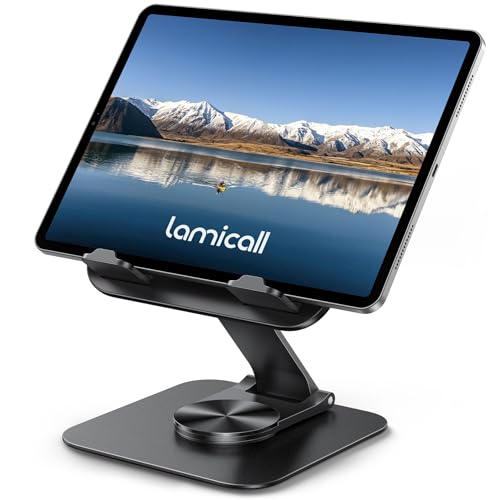
The Lamicall Adjustable iPad Stand with Rotating Base is the best foldable tablet stand for desks because it pairs a heavy metal base with a frame that folds slim and rotates a full circle. The stand is an ultra-slim folding frame on a heavy-duty metal base, with dual-axis adjustment that tilts and raises the tablet, and the base rotates 360 degrees, which suits a desk where the tablet turns to face a second person or a second work position. It accepts tablets from 4.7 to 13 inches, which covers the largest mainstream tablets, and it holds them in portrait or landscape, because the cradle is deep enough to catch the bottom edge in either orientation. The heavy base is the feature that makes the rotation work: a rotating stand on a light base walks across the desk when it turns, and this base is heavy enough to stay where it is put. The listing data reviewed carries the identifier for the exact listing pinned in the reference table below.
The published figures back the design up. The listing data reviewed gives the stand as the foldable rotating model with a heavy-duty metal base, dual-axis adjustment and a 360-degree rotating base, per the maker and the listing data, and the frame folds slim enough to slip into a laptop bag, which is the reason it leads the foldable case among the premium stands. The stand is sold through the maker’s own Amazon store, and the listing data reviewed shows it as a current Amazon listing. The listing data reviewed carries the identifier for the exact listing pinned in the reference table below.
The qualifications are about the hinges and the height. The folding frame has hinges, which is the price of portability, and hinges are the one part of a stand that can loosen over time, so the frame should be folded gently rather than snapped open, and a buyer who never moves the stand should favor one of the single-piece cradles above. The height lift is less than the lift on the LISEN, so a buyer who wants the tallest possible screen should favor the LISEN, and this stand should be bought for its rotation and its foldability rather than for its height. And the heavy base, while the reason the rotation works, also makes the stand the least portable of the folding stands in the guide, so it suits a desk where the stand stays put and the tablet comes and goes. What the money buys is a heavy metal base that holds the rotation steady, a 360-degree rotating base, dual-axis adjustment, and a frame that folds slim for travel. For a desk that wants the stand to rotate and then disappear, that is a coherent place for it to sit.
Specs
- Max tablet size: 13 in, per the listing data reviewed
- Min tablet size: 4.7 in, per the listing data reviewed
- Material: Metal, heavy-duty base
- Adjustment: Angle and height, dual-axis, 360-degree rotation
- Orientation: Portrait and landscape
- Foldable: Yes, ultra-slim folding frame
- Base: Heavy-duty metal base
- Pads: Rubber pads on base and cradle
Care and Safety Tips
A tablet stand works best when it is matched to the tablet and the desk before it is bought, and the check takes a minute. Measure the tablet with its case on, check the stand’s maximum size against that number, and check the desk depth against the stand’s footprint, because a stand that is wider than the free desk space ends up half off the edge. Keep the rubber pads clean, because dust on the pads is the reason a stand starts to slide on a smooth desk, and wipe the pads with a damp cloth every few weeks. Check the hinges on a folding stand every few months, and tighten any adjustment screw that has worked loose, because a hinge that slips is a tablet that falls. Keep the stand away from the desk edge, and route the charging cable so it does not pull the tablet forward when it is plugged in.
No CPSC recall covers desktop tablet stands as a class, and none of the five picks in this guide appears in any recall notice. The recall records below cover different products, and each is a different product from the passive stands in this guide. The Belkin Auto-Tracking Stand Pro, model number MMA008, was recalled in November 2025 under CPSC number 26-090, after the lithium-ion battery in the stand could overheat, with about 83,500 units sold in the United States, one report of a fire in the United States and fifteen reports internationally, including two minor burn injuries. That stand is a motorized, battery-powered tracking stand with wireless charging, which is a different product from every pick in this guide, because none of the five picks has a battery, a motor or a charging port. The same announcement covered the Belkin BoostCharge power bank and the Playa power bank, which are power banks, not stands. The Jimco Lamps accent tables with built-in charging receptacles were recalled after the receptacles, including the USB ports, may have been wired with reversed polarity, covering about 99,000 units in the United States, and those are side tables with outlets, not tablet stands. The VARIDESK Stand2Learn stools were recalled in January 2020 after a support bar could break, and those are stools, not stands. None of these records touches a passive desktop tablet stand, and none of them touches any pick in this guide.
A final note on the class: a tablet stand is a passive holder, and the only safety question it raises is whether the tablet stays put. A stand with a battery or a charging port is a different class of product, and it carries the battery and wiring risks that a passive stand does not, so a buyer who wants charging built into the stand should check the recall record for that specific model before ordering. A buyer who uses the tablet for video calls should also check that the stand holds the tablet steady at the chosen angle, because a tablet that slips mid-call is the most common complaint in the class, and the fix is a deeper hook and a wider base rather than a heavier stand.
Frequently Asked Questions
Will a tablet stand fit a 12.9-inch iPad Pro?
Four of the five picks in this guide accept tablets up to 13 inches, which covers a 12.9-inch tablet with room to spare, and the LISEN accepts up to 12.9 inches, which covers the same tablet bare but leaves no room for a thick case. Measure the tablet with its case on before ordering, and favor the 13-inch picks when the case is thick, because the hook depth is the dimension that decides whether the tablet sits securely.
Do tablet stands work with a tablet in a case?
Yes, when the case is slim, because all five picks are sized for tablets with cases on, and the rubber pads grip the case as well as they grip a bare tablet. A rugged case with a thick back, a built-in hand strap or a keyboard can add enough depth that the tablet no longer sits deep in the hook, so measure the tablet with the case on and compare it with the stand’s maximum size before ordering.
Can a tablet stand hold a phone too?
Yes, all five picks hold a phone as well as a tablet, because the hook catches any device from about 4 inches upward, and a phone sits lower in the cradle than a tablet does. A phone in a stand is a good second screen for messages and calls, but a phone is light enough that a small dedicated phone stand may suit a desk better when the tablet stand is in use.
Is a heavier stand always more stable?
No, a heavier stand is more stable only when the weight sits in the base, because stability comes from the footprint and the rubber pads as much as from the weight. A tall adjustable stand on a narrow base can rock even when it is heavy, while a low cradle on a wide base stays put with less weight, so check the base width and the pads alongside the weight before ordering.
Conclusion
The classic Lamicall adjustable stand is the best tablet stand for desks for most buyers, because the wide aluminum base holds the screen still, the deep hook takes tablets from 4 to 13 inches in either orientation, and there are no hinges to loosen. The OMOTON T1 is the honest budget pick for a large tablet, with the longest support arms among the budget stands and a hollow frame that keeps the tablet cool. The UGREEN stand is the value pick for a desk that wants a thicker base and a frame that folds flat, and the LISEN stand is the premium pick for a desk that wants height, with the tallest lift in the guide and a 360-degree rotating base. The Lamicall rotating model is the premium pick for a desk that wants the stand to rotate and then fold away. Measure the tablet with its case on, check the base width, favor height adjustment when the tablet is a second screen, and favor a single-piece cradle when the stand never moves. The stand that fits the tablet and the desk is the stand that gets used, and the stand that gets used is the only one that helps.