Key takeaways
- Compare five stainless braided washer hoses by length, burst strength, fittings, and warranty, then choose a leak-resistant pair for your laundry room.
A washer hose does its job out of sight, and that is exactly why it deserves attention. When a rubber hose weakens and bursts, water can pour into a laundry room for hours before anyone notices, soaking floors, walls, and whatever sits below. Choosing a stainless braided hose is less about the braid itself and more about buying time: stronger walls, fittings that seal without constant retightening, and a length that reaches the valves without pulling tight every time the machine vibrates through a spin cycle.


This guide suits homeowners swapping out old rubber hoses before they fail, renters hooking up a new washer for the first time, and anyone whose machine sits farther from the supply valves than the hoses that came in the box allow. Every pick below comes from Amazon product titles and listing specifications, so you can compare lengths, burst ratings, fittings, and warranties side by side and order the pair that fits your laundry room.
Quick Picks
As an Amazon Associate we earn from qualifying purchases.
| Product | Best for | Key spec from title |
|---|---|---|
| K&J Premium 6 ft Stainless Steel Washer Hoses, 2-Pack | Replacing a worn pair in a standard hookup | 6-foot burst-proof pair for hot and cold water |
| GE PM14X10005 4-Foot Stainless Steel Washer Hoses, 2-Pack | A shorter run with a high burst rating | 1600 psi burst rating with a polymer coating |
| Eastman 41066 6-Foot Braided Stainless Steel Washer Connectors, 2-Pack | Tight hookups that need angled fittings | 6-foot braided pair with elbows and 3/4-inch fittings |
| Beaquicy 6-Foot Stainless Steel Washer Hoses with 90-Degree Elbows, 2-Pack | A machine pushed close to the wall | 6-foot red and blue pair with a 10-year warranty |
| Techecook 4-Foot Premium Stainless Steel Washer Hoses, 2-Pack | A compact laundry closet with straight valves | 4-foot 304 stainless steel pair with a 10-year warranty |
How to Choose
Measure the Run Before You Order
Start with a tape measure rather than a guess. Measure from the supply valves on the wall to the inlet ports on the back of the washer, then add enough slack for the hose to curve gently instead of pulling taut. A hose under tension tugs at its fittings every time the machine shakes, and that slow strain is what loosens seals over months of use. A 4-foot pair suits a washer that sits close to its valves, while a 6-foot pair covers machines set farther out or valves placed off to one side. Ordering too short forces a stretched install, and ordering far too long leaves loops that can kink behind the machine.
Check Burst Strength and Braid Material
Every hose in this guide carries a stainless steel braid, but the braid alone does not tell the whole story. Look for a burst rating on the listing, because that number describes how much pressure the hose is built to withstand before failing. The GE pair in this guide lists a 1600 psi burst rating, and the K&J pair is described as burst-proof on its listing. Two picks here state 304 stainless steel in their specifications, a grade commonly used for braided supply lines. Whatever you choose, read the listing itself for the burst figure and the steel grade instead of assuming one braided hose performs like another.
Look Closely at the Fittings
Fittings decide whether a hose seals on the first try or drips for a week. Check that the connector thread matches your supply valves and the washer inlets before you order, since a mismatched thread will not seal no matter how firmly you tighten it. The Eastman pair in this guide lists 3/4-inch female hose thread fittings, which is the size most laundry hookups use. Elbow fittings matter too: when a washer sits close to the wall, a straight connector forces the hose into a sharp bend, while a 90-degree elbow lets it turn cleanly. Both elbow pairs in this guide solve that problem in different lengths.
Plan for Replacement Instead of Forever
Even a stainless braided hose has a service life, and treating it as a fit-and-forget part is how slow leaks start. Two hoses in this guide carry a 10-year warranty, which gives a useful yardstick for how long the maker expects the pair to last. Build a habit of looking behind the washer every few months for dampness, bulging, rust on the braid, or corrosion around the fittings. Replace the pair at the first sign of wear rather than waiting for a failure, and always swap both hoses together so the older one does not become the weak link.
The 5 Best Options
K&J Premium 6 ft Stainless Steel Washer Hoses
This pair fits the homeowner who wants a straightforward replacement for an aging set of rubber hoses without measuring a tight space or learning fitting sizes. The 6-foot length covers most standard laundry hookups with slack to spare, and the listing describes the hoses as burst-proof, which addresses the exact failure that floods laundry rooms. One hose serves the hot water line and the other serves the cold, so the swap is a simple like-for-like job. It is the pick for anyone who wants a longer, stronger pair and a quick install.
Specs
- Length: 6 feet
- Pack: 2 hoses
- Construction: stainless steel braid, described as burst-proof on the listing
- Configuration: one hose for hot water and one for cold water
Best for: Replacing an old rubber pair in a standard laundry hookup with room to spare.
Watch out for: Measure your run first, since 6 feet leaves a long loop behind a washer that sits very close to its valves.
GE PM14X10005 4-Foot Stainless Steel Washer Hoses
This pair suits a shorter hookup where the washer sits near the wall valves and the buyer wants a stated burst figure to lean on. The listing gives a 1600 psi burst rating, the clearest pressure number among the five picks here, and a polymer coating over the braid that shields the steel from scrapes and moisture in a cramped laundry space. The 4-foot length keeps the run short and tidy behind a machine that does not need extra reach. It is also the only pick here listed as made in the USA, which matters to buyers who weigh origin alongside performance.
Specs
- Model: PM14X10005
- Length: 4 feet
- Pack: 2 hoses
- Burst rating: 1600 psi
- Coating: polymer coating over the stainless steel braid
- Origin: Made in USA
Best for: A short, close-to-the-wall hookup where a high stated burst rating matters.
Watch out for: Confirm 4 feet reaches both of your valves with slack, since this is the shorter length in the guide.
Eastman 41066 6-Foot Braided Stainless Steel Washer Connectors
This pair is built for hookups where straight connectors would force the hose into a hard bend. The elbow fittings let the hose turn cleanly away from the wall, which helps when the washer sits close to the valves or the valves sit low behind the machine. The listing states 304 stainless steel braid and 3/4-inch female hose thread fittings, so both the material grade and the thread size are spelled out rather than left to guesswork. At 6 feet, the pair also covers valves placed off to the side. It is the most clearly specified pick in the group for buyers who want the numbers on the listing.
Specs
- Model: 41066
- Length: 6 feet
- Pack: 2 hoses
- Material: 304 stainless steel braid
- Fittings: elbow connectors with 3/4-inch female hose thread
- Configuration: braided stainless steel washer connectors
Best for: Tight hookups where elbow fittings keep the hose from bending sharply at the wall.
Watch out for: Check the elbow direction against your valve layout, since the bend helps only when it points the hose toward the washer inlets.
Beaquicy 6-Foot Stainless Steel Washer Hoses with 90-Degree Elbows
This pair fits a machine pushed close to the wall, where the gap behind the washer is too narrow for a straight connector and a gentle curve. The 90-degree elbows turn the hose downward right at the fitting, and the red and blue hoses make it easy to tell the hot line from the cold line during install and later checks. The listing states a temperature range of 15 to 158 degrees Fahrenheit and backs the pair with a 10-year warranty, two concrete figures that help a buyer judge durability. At 6 feet, it also reaches valves that sit farther from the machine than a short pair would allow.
Specs
- Length: 6 feet
- Pack: 2 hoses, red and blue
- Construction: stainless steel braid with 90-degree elbow fittings
- Temperature range: 15 to 158 degrees Fahrenheit
- Warranty: 10-year warranty
Best for: A washer pushed close to the wall where color-coded hoses and elbow fittings simplify the hookup.
Watch out for: Verify the 6-foot length against your valve distance, since the elbows solve bending but do not shorten the run.
Techecook 4-Foot Premium Stainless Steel Washer Hoses
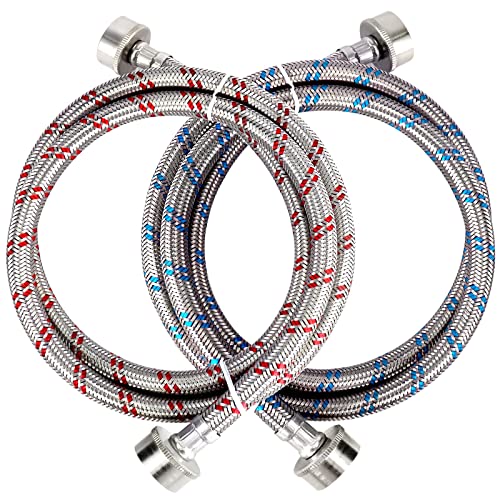
This pair suits a compact laundry closet where the valves sit directly behind the washer and a short, straight run is all the job needs. The listing states 304 stainless steel, matching the material grade given for the Eastman pair, and backs the hoses with a 10-year warranty. The 4-foot length avoids the coils of slack that a longer hose would leave in a tight space, and the two-hose pack covers hot and cold in one order. It is the simplest pick in the guide: a short premium pair for a hookup that does not need elbows or extra reach.
Specs
- Length: 4 feet
- Pack: 2 hoses
- Material: 304 stainless steel
- Construction: premium stainless steel braid
- Warranty: 10-year warranty
Best for: A compact laundry closet with straight valves close behind the washer.
Watch out for: This pair has no elbow fittings, so skip it if your washer sits so close to the wall that a straight connector would kink the hose.
Which One Fits Your Situation
Replacing an Aging Rubber Pair
If your current hoses are rubber and several years old, swap both at once instead of waiting for one to fail. The K&J 6-foot pair is the natural choice here: its length fits most standard hookups, its burst-proof description addresses the failure you are trying to avoid, and the hot-and-cold pair makes the swap a direct replacement. Check the valves for corrosion while the old hoses are off, then install the new pair and watch the connections for drips.
Hooking Up a Washer Far From the Valves
When the supply valves sit away from the washer inlets, length decides the purchase. Both 6-foot pairs in this guide reach farther than the 4-foot options, so choose between them by fitting shape. Pick the Eastman 41066 when the hose must turn sharply at the wall, and pick the Beaquicy pair when you also want red and blue color coding to keep hot and cold straight. Leave a gentle curve in the hose rather than pulling it taut.
Fitting a Machine Into a Tight Alcove
A washer squeezed into an alcove leaves no room behind it, and that is where elbow fittings earn their place. The Beaquicy pair turns the hose at a right angle at the fitting, so the machine can sit closer to the wall without crushing the hose. The Eastman pair does the same job with its elbow connectors and adds a stated 304 stainless steel grade and 3/4-inch thread size. Choose Beaquicy for color coding, Eastman for the fitting size.
Keeping a Short Hookup Simple
Some laundry rooms need nothing fancy: valves directly behind the washer, a straight run, and no tight bends. A 4-foot pair keeps the install tidy. Choose the GE PM14X10005 when a stated 1600 psi burst rating and a polymer-coated braid matter most, and choose the Techecook pair when you want 304 stainless steel with a 10-year warranty at the same length. Both cover hot and cold in one pack, and neither leaves excess hose coiled behind the machine.
Common Mistakes
- Ordering by guess instead of measuring from the valves to the washer inlets, then finding the hose too short or coiled into a kink.
- Tightening fittings with excessive force, which can crack the connector or crush the seal and cause the very leak you wanted to prevent.
- Pushing the washer back until it pinches the hoses against the wall, instead of leaving a gentle curve with room for vibration.
- Replacing only the hose that looks worn and leaving its older partner in place to fail next.
- Installing the new pair and walking away without running a cycle and checking both connections for slow drips.
Frequently Asked Questions
How often should washer hoses be replaced?
Plan on replacing washer hoses every few years rather than waiting for a failure, and inspect them at least once a year. Look for bulging, cracks in the braid, rust, corrosion at the fittings, or dampness on the floor behind the machine. Any of those signs means swapping the pair at once, and always replace both hoses together so the older one does not become the next failure point.
Are stainless braided hoses better than rubber hoses?
A stainless steel braid adds a layer of protection that plain rubber lacks, resisting abrasion, kinking, and the slow wear that leads to bursts. That does not make a braided hose indestructible, and it still needs regular inspection and replacement on a schedule. The real advantage is time: a braided hose tolerates the pressure spikes and vibration of wash cycles better than an unreinforced rubber hose of the same age.
Do I need hoses with elbows?
Elbows help when the washer sits close to the wall or the valves sit low, because a connector forces the hose into a bend that can kink or strain the fitting. If your machine has room behind it and the valves line up with the inlets, a pair works fine. The Eastman and Beaquicy picks here both include elbow fittings, so choose one when clearance behind the washer is tight.
Can I install washer hoses myself?
Most homeowners can handle this job with care. Turn off both supply valves first, unscrew the old hoses, and connect the new pair with hot to hot and cold to cold. Tighten the fittings firmly by hand, then a small amount further with pliers, taking care not to overtighten. Turn the water back on slowly, run a cycle, and check both connections for drips before pushing the washer into place.