Key takeaways
- Compare the best desk speakers, from the compact Creative Pebble V2 to the Klipsch ProMedia 2.1, with power, inputs, Bluetooth, and desk fit.
The best desk speaker is the Edifier R1280T, because its 42 watts of RMS power, its 4 inch woofers, and its wooden enclosures give a desk a full, warm sound that small plastic speakers cannot match, with bass and treble controls on the side of the active speaker and a remote control that adjusts the volume from the chair, which is the combination that matters most on a real desk, where the speakers must fill the space in front of one person with clear voices, music, and video sound without demanding attention, without claiming the whole work surface, and without forcing the person at the desk to reach behind a monitor to change the volume. The speakers built into a monitor or a laptop are thin and quiet by design, because they are squeezed into a frame that was built for a screen rather than for sound, and they leave voices sounding hollow, music sounding flat, and video calls sounding distant, while a pair of dedicated desk speakers aimed at the chair fixes all three at once, because the drivers are larger, the enclosures are deeper, and the sound reaches the ears directly instead of bouncing off a desk from a downward-facing slot. The Edifier does that job with a pair of powered bookshelf speakers that connect to a computer with a standard audio cable, that offer two inputs so a second device can stay connected at the same time, and that let the listener shape the sound with physical bass and treble dials, so the sound can be tuned to the room rather than accepted as it arrives. The wooden enclosures add weight and warmth that plastic cabinets cannot, the 13 millimeter silk dome tweeters keep high notes smooth rather than sharp, and the remote control means the volume, the mute, and the input can all be changed without standing up, which is the kind of everyday convenience that decides whether speakers get used every day or sit silent beside the monitor. That combination of real power, real drivers, real enclosures, and real controls is why it leads this guide, and the fact that the same design has served desks, bedrooms, and small studios for a decade is why it stays there, because a speaker that has survived that much daily use has already passed the only test that matters.
If the desk is small and the speakers must be smaller still, the Creative Pebble V2 is the honest compact pick, with USB-C power drawn straight from the computer, up to 8 watts of RMS power, and drivers angled upward at 45 degrees so the sound reaches the ears instead of the desk surface, in a pair of small spheres that fit on either side of a monitor without claiming the work surface, so it suits a desk that has no room to spare and a worker who wants better sound without a second power cable. The Logitech Z207 is the pick for a desk where the sound should come from more than one device, because it adds Bluetooth to a standard wired connection and switches between a computer and a phone with one button, with a headphone jack on the front for private listening, so one pair of speakers covers a laptop, a phone, and a tablet without replugging anything. The Bose Companion 2 Series III is the premium pick for a desk where voices and music must sound natural, because its ported cabinet design and its TrueSpace stereo processing widen the sound beyond the two small boxes, with two inputs for a computer and a second device and a headphone jack on the front of the right speaker, so it suits a desk where calls, music, and video all share the same pair of speakers. The Klipsch ProMedia 2.1 is the pick for a desk where bass matters, because it adds a 6.5 inch subwoofer to a pair of satellite speakers and carries THX certification, with a control pod that adjusts the volume and the subwoofer level from the desk, so it suits a desk where music, movies, and games need low notes that a two-speaker set cannot reach. One honest note up front: every pick here is a wired pair of desk speakers that connects to a computer with a standard audio cable, and none of them is a battery-powered portable speaker or a whole-room soundbar, so a buyer who wants a speaker that travels should look at a portable model instead, and a buyer who wants to fill a living room should look at a soundbar or a home theater set instead. Below, we compare five verified desk speakers across power, driver size, inputs, Bluetooth, and desk fit, so the choice rests on the desk and the listening rather than on the speaker that looks tidiest in a photograph. One scope note: every pick here is sized for a desk or a small personal space, and none of them is a large floor-standing speaker that belongs beside a television.
As an Amazon Associate, we earn from qualifying purchases.
Table of Contents
- Quick Picks at a Glance
- Quick Comparison
- How to Choose a Desk Speaker
-
- Edifier R1280T Powered Bookshelf Speakers
-
- Creative Pebble V2 Minimalistic 2.0 USB-C Desktop Speakers
-
- Logitech Z207 2.0 Stereo Computer Speakers with Bluetooth
-
- Bose Companion 2 Series III Multimedia Speakers
-
- Klipsch ProMedia 2.1 THX Certified Computer Speaker System
- Care and Safety Tips
- Frequently Asked Questions
- Conclusion
- Product and ASIN Reference
Quick Picks at a Glance
- Best overall: Edifier R1280T Powered Bookshelf Speakers — 42 watts of RMS power with 4 inch woofers, wooden enclosures, and a remote control, for full sound at a desk.
- Best compact: Creative Pebble V2 Minimalistic 2.0 USB-C Desktop Speakers — USB-C power with up to 8 watts of RMS power and 45-degree angled drivers, for a crowded desk.
- Best Bluetooth: Logitech Z207 2.0 Stereo Computer Speakers with Bluetooth — Bluetooth multi-device switching with a wired input and a front headphone jack, for a desk with more than one device.
- Best premium: Bose Companion 2 Series III Multimedia Speakers — ported cabinets with TrueSpace stereo processing and dual inputs, for natural voices and music.
- Best bass: Klipsch ProMedia 2.1 THX Certified Computer Speaker System — a 6.5 inch subwoofer with THX certification and a desktop control pod, for low notes a two-speaker set cannot reach.
Quick Comparison
| Product | Power | Drivers | Standout | Tier |
|---|---|---|---|---|
| Edifier R1280T | 42 W RMS | 4 in woofers, 13 mm tweeters | Wooden enclosures and remote | Mid-range |
| Creative Pebble V2 | Up to 8 W RMS | 2 in full-range drivers | USB-C power, 45-degree angle | Budget |
| Logitech Z207 | 10 W peak | Stereo pair | Bluetooth multi-device switching | Budget |
| Bose Companion 2 Series III | Powered pair | Ported cabinets | TrueSpace stereo processing | Premium |
| Klipsch ProMedia 2.1 | 200 W peak system | 6.5 in subwoofer | THX certification, control pod | Premium |
How to Choose a Desk Speaker
Start with the power, because the power decides whether the speakers fill the space in front of the desk or strain to be heard. A pair rated around 40 watts RMS, like the Edifier at 42 watts, plays clearly at normal listening levels with room to spare, while a compact USB-powered pair like the Creative Pebble V2 at up to 8 watts RMS is built for close-range listening at arm’s length, and a set with a subwoofer like the Klipsch at 200 watts of peak system power is built for music and movies where the low notes need real force. Measure the listening distance first, not the room, because a desk speaker serves one person sitting about an arm’s length away, and a pair that is loud enough at that distance is loud enough for the desk, while a pair that must be turned to its limit to reach the chair will distort before it satisfies. Write down how far the speakers will sit from the chair, and choose power that covers that distance with headroom to spare, because a speaker played near its limit sounds harsh, and a speaker played in the middle of its range sounds relaxed.
Driver size comes second, and it decides how full the sound feels. A larger woofer moves more air and reaches lower notes, which is why the Edifier with its 4 inch woofers sounds fuller than a compact pair with 2 inch drivers, and why the Klipsch with its 6.5 inch subwoofer reaches notes that no two-speaker set can touch. A separate tweeter matters too, because a small full-range driver must handle the highs and the lows at once, while a pair with a dedicated silk dome tweeter, like the Edifier, keeps voices and cymbals smooth and distinct. Listen for the low end first when comparing, because a speaker that cannot reproduce the low notes will make music sound thin and voices sound hollow, and a speaker with a real woofer or a subwoofer will make the same recording sound complete. The Bose pick in this guide takes a different route, using ported cabinets and stereo processing to widen the sound from small drivers, which suits a desk where the speakers must stay small but the sound must still feel open.
Inputs come third, and they decide how many devices the speakers can serve. Every pick in this guide connects to a computer with a standard 3.5 millimeter audio cable, which is the baseline, and the differences sit above it. The Edifier offers two inputs, so a computer and a second device can stay connected at the same time. The Logitech Z207 adds Bluetooth, so a phone or a tablet can stream music without a cable, and it switches between the wired computer and the Bluetooth device with one button, which is the feature that matters most on a desk where the phone is the second source. The Bose pick also offers two inputs, for a computer and a second device, while the Creative Pebble V2 keeps it simple with one wired input and USB power from the same computer. Count the devices before ordering, and choose inputs that cover them all, because a speaker with one input forces a cable swap every time the source changes, and a speaker with two inputs or Bluetooth never does.
Desk fit comes fourth, and it decides whether the speakers get used or get in the way. Measure the free surface on either side of the monitor, check the height under any shelf above the desk, and note where the power outlet sits, because a pair of bookshelf speakers like the Edifier needs real space on both sides, while a compact pair like the Creative Pebble V2 fits in the gaps beside a monitor stand and a coffee mug. The Klipsch set needs a third space as well, because the subwoofer sits on the floor or under the desk, which is a different kind of footprint than a pair of satellites. Check the cable lengths before ordering, and picture the cables running from the computer to the speakers and from the speakers to the outlet, because a cable that must stretch across the desk gets pulled, and a cable that runs behind the desk stays out of the way. The speaker that fits the desk, reaches the outlet, and leaves room for the keyboard is the speaker that stays on the desk, and the speaker that crowds the work surface is the speaker that ends up in a cupboard.
Finally, weigh what the speakers cannot do, because a desk speaker fills the space in front of one person and it should not be asked to fill a whole room. A desk pair raises the sound at the chair and in a small room, and it does not replace a soundbar or a home theater set in a large open-plan space, so a desk in a large room should favor the Klipsch with its subwoofer and higher system power, and a desk in a small room will be served by any pick in this guide. A desk speaker also needs its drivers aimed at the ears, because sound that fires at the desk surface or at a wall loses its clarity before it arrives, which is why the Creative Pebble V2 angles its drivers upward and why the Edifier and Bose picks should sit at ear height or tilted slightly toward the chair. The speaker that fits the desk, matches the listening distance, covers the devices, and aims at the ears is the speaker that gets used, and the speaker that gets used is the only one that helps.
1. Edifier R1280T Powered Bookshelf Speakers
Tier: Mid-range
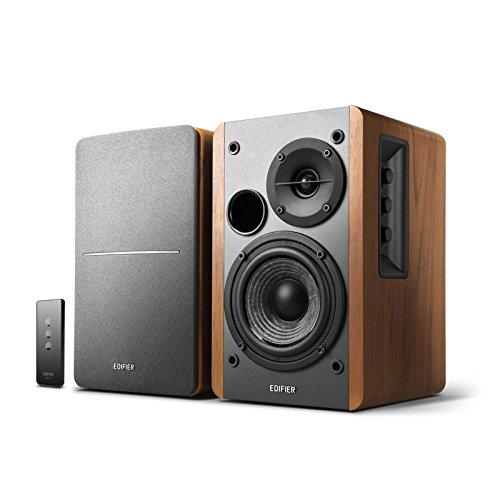
The Edifier R1280T is the best desk speaker for most buyers, because its 42 watts of RMS power, its 4 inch woofers, and its wooden enclosures give a desk a full, warm sound that small plastic speakers cannot match, with bass and treble controls on the side of the active speaker and a remote control that adjusts the volume from the chair, so it covers a full workday of calls, music, and video without a refill of attention. The pair is a powered 2.0 bookshelf set, which means the amplifier is built into one speaker and the second speaker connects to it, so the setup is one audio cable from the computer and one power cable to the outlet, with no separate amplifier box on the desk. The wooden enclosures add weight that keeps the speakers planted and warmth that plastic cabinets cannot, the 13 millimeter silk dome tweeters keep high notes smooth rather than sharp, and the dual inputs let a computer and a second device stay connected at the same time. The listing data reviewed carries the identifier for the exact listing pinned in the reference table below.
The published figures back the design up. The total power of 42 watts RMS, split as 21 watts per channel, is the strongest two-speaker output in this guide, which is why the Edifier plays clearly at normal listening levels with headroom to spare, and the 4 inch woofers reach lower notes than the compact picks, so music sounds complete rather than thin. The signal-to-noise ratio of 85 decibels or better, according to the maker, keeps the background hiss low during quiet passages and silent moments on calls, and the side-mounted bass and treble dials let the listener shape the sound to the room, turning the bass down in a small room or up when the recording needs weight. The remote control adjusts the volume, mutes the sound, and switches between the two inputs, which means the listener never reaches behind the monitor to change anything, and the pair is built for shelves and tabletops, according to the maker, so it sits naturally on either side of a monitor. The listing data reviewed carries the identifier for the exact listing pinned in the reference table below.
The qualifications are about the size, the inputs, and the extras. The bookshelf bodies are larger than the compact picks in this guide, so a desk with almost no free surface should favor the Creative Pebble V2 below, which is smaller, or the Logitech Z207 below, which is slimmer. The pair has no Bluetooth, so a buyer who wants to stream from a phone without a cable should favor the Logitech Z207 below, which offers it, and the pair has no subwoofer, so a buyer who wants deep bass for movies and games should favor the Klipsch below, which adds one. The remote control is infrared, so it needs a line of sight to the active speaker, which is a small detail that matters on a desk where the speaker sits behind a monitor. What the money buys is a powered pair of wooden bookshelf speakers with 42 watts of RMS power, 4 inch woofers, silk dome tweeters, tone controls, dual inputs, and a remote control, at a mid-range tier. For a desk that needs full sound without a subwoofer, that is a coherent place for it to sit.
Specs
- Power: 42 W RMS total, 21 W per channel, per the maker
- Woofer: 4 in per speaker, per the maker
- Tweeter: 13 mm silk dome, per the maker
- Enclosure: Wood, per the maker
- Inputs: Dual RCA inputs, per the maker
- Controls: Side bass and treble dials, per the maker
- Remote: Wireless remote for volume, mute, and input, per the maker
- Signal-to-noise ratio: 85 dBA or better, per the maker
- Mounting: Shelf or tabletop, per the maker
- Weight: About 10.78 lb for the pair, per independent coverage
2. Creative Pebble V2 Minimalistic 2.0 USB-C Desktop Speakers
Tier: Budget
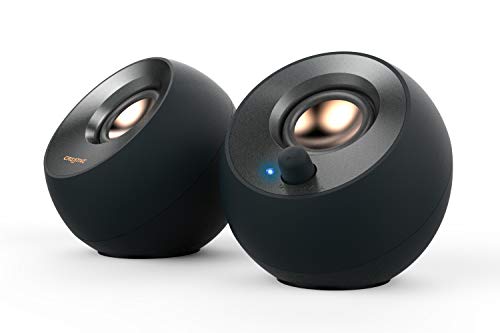
The Creative Pebble V2 is the best desk speaker for a crowded desk, because it draws its power from the computer over USB-C, delivers up to 8 watts of RMS power, and angles its drivers upward at 45 degrees so the sound reaches the ears instead of the desk surface, in a pair of small spheres that fit on either side of a monitor without claiming the work surface. The pair is a 2.0 USB-powered set, which means there is no power brick and no wall outlet to find, because the speakers take their power from the same computer they play from, and the 3.5 millimeter audio cable carries the sound while the USB-C cable carries the power. The drivers are 2 inch full-range units set into a rounded body that lifts the sound toward the listener, the included Type-A adapter covers computers that still use the older USB port, and the extended cable gives the pair room to sit on either side of a wide monitor. The listing data reviewed carries the identifier for the exact listing pinned in the reference table below.
The published figures back the design up. The power of up to 8 watts RMS is modest beside the Edifier above, but it is sized for close-range listening at arm’s length, which is exactly where a desk speaker sits, so the pair plays clearly at normal desk volume without strain. The 45-degree elevated drivers are the feature that sets the design apart, because a speaker that fires straight ahead from desk level sends much of its sound into the desk surface, while a speaker angled upward sends it to the ears, which makes voices clearer and music more present at the same volume. The USB-C power means the pair works with a laptop on the road as well as a desktop at home, because any computer with a USB port can power it, and the 3.5 millimeter input works with any device that has a headphone jack, so the pair covers a laptop, a desktop, and a tablet without an adapter. The listing data reviewed carries the identifier for the exact listing pinned in the reference table below.
The qualifications are about the bass, the inputs, and the volume. The 2 inch drivers cannot reach the low notes that the Edifier above reaches with its 4 inch woofers, so a buyer who wants deep bass for music and movies should favor the Klipsch below, which adds a subwoofer. The pair has one wired input and no Bluetooth, so a buyer who wants to stream from a phone without a cable should favor the Logitech Z207 below. The USB power draws from the computer, so a laptop running on battery will see its battery drain a little faster while the speakers play, which is a small cost that matters on a long day away from an outlet. What the money buys is a pair of compact USB-C powered desktop speakers with up to 8 watts of RMS power, 45-degree angled drivers, a 3.5 millimeter input, and a Type-A adapter, at a budget tier. For a desk that has almost no room to spare, that is a coherent place for it to sit.
Specs
- Power: Up to 8 W RMS, per the maker
- Drivers: 2 in full-range, per the maker
- Angle: 45-degree elevated drivers, per the maker
- Power supply: USB-C, Type-A adapter included, per the maker
- Input: 3.5 mm AUX-in, per the maker
- Design: Minimalistic 2.0 desktop pair, per the maker
- Use: Computers and laptops, per the maker
3. Logitech Z207 2.0 Stereo Computer Speakers with Bluetooth

Tier: Budget
The Logitech Z207 is the best desk speaker for a desk where the sound should come from more than one device, because it adds Bluetooth to a standard wired connection and switches between a computer and a phone with one button, with a headphone jack on the front for private listening, so one pair of speakers covers a laptop, a phone, and a tablet without replugging anything. The pair is a 2.0 stereo set with 10 watts of peak power, which is sized for close-range listening at a desk, and the on-speaker controls put the volume, the Bluetooth pairing, and the input switch within reach, so the listener never opens a settings menu to change sources. The Bluetooth connection pairs with a phone or a tablet for music and podcasts, the wired 3.5 millimeter input stays connected to the computer for calls and video, and the Easy-Switch button moves between the two without touching a cable, which is the feature that matters most on a desk where the phone is the second source. The listing data reviewed carries the identifier for the exact listing pinned in the reference table below.
The published figures back the design up. The peak power of 10 watts is the smallest headline figure in this guide, but it is honest about the job, because the pair is built for one person at arm’s length rather than for a room, and at that distance the sound is clear and present without distortion. The Bluetooth multi-device support is the standout, because most desk speakers in this tier offer either a wired input or Bluetooth, and the Z207 offers both, with a dedicated button that switches between them, so a call on the computer and a song on the phone never compete for the same input. The front headphone jack turns the pair into a private listening station with one plug, which suits a shared room or an open office where the speakers must go quiet in a moment, and the compact stereo pair fits on either side of a monitor without claiming the work surface. The listing data reviewed carries the identifier for the exact listing pinned in the reference table below.
The qualifications are about the bass, the power, and the range. The pair has no subwoofer and no separate tweeter, so it cannot reach the low notes that the Edifier above reaches with its 4 inch woofers, and a buyer who wants deep bass should favor the Klipsch below. The 10 watts of peak power is enough for a desk and not enough for a room, so a buyer who wants to fill a larger space should favor the Edifier above or the Klipsch below. The Bluetooth range is the range of a desk, so a phone left in another room will drop the connection, which is a small limit that matters only when the phone wanders. What the money buys is a pair of stereo computer speakers with Bluetooth multi-device switching, a wired input, a front headphone jack, and on-speaker controls, at a budget tier. For a desk with more than one device, that is a coherent place for it to sit.
Specs
- Power: 10 W peak, per the maker
- Configuration: 2.0 stereo pair, per the maker
- Wireless: Bluetooth multi-device, per the maker
- Switching: Easy-Switch button between wired and Bluetooth, per the maker
- Input: 3.5 mm audio input, per the maker
- Output: Front headphone jack, per the maker
- Controls: On-speaker volume and Bluetooth pairing, per the maker
- Use: Computer, tablet, and smartphone, per the maker
4. Bose Companion 2 Series III Multimedia Speakers
Tier: Premium
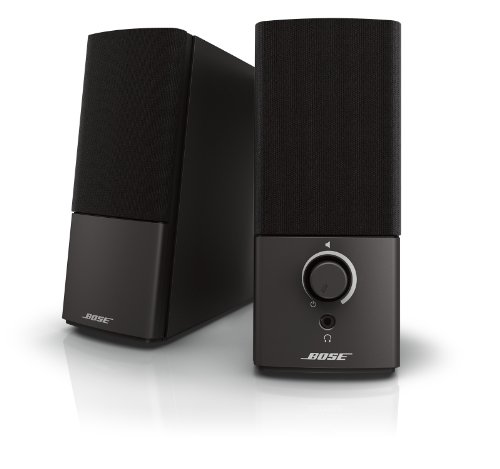
The Bose Companion 2 Series III is the best desk speaker for a desk where voices and music must sound natural, because its ported cabinet design and its TrueSpace stereo processing widen the sound beyond the two small boxes, with two inputs for a computer and a second device and a headphone jack on the front of the right speaker, so it suits a desk where calls, music, and video all share the same pair of speakers. The pair is a powered multimedia set, which means the amplifier is built in and the setup is one audio cable from the computer and one power cable to the outlet, with a volume control on the front of the right speaker that stays within reach all day. The ported cabinets give the small drivers more low-end weight than a sealed box of the same size, the TrueSpace processing spreads the stereo image wider than the physical gap between the speakers, and the dual inputs let a computer and a second device stay connected at the same time, so the listener never swaps a cable to change sources. The listing data reviewed carries the identifier for the exact listing pinned in the reference table below.
The published figures back the design up. The design is the feature that sets the pair apart, because the ported cabinets and the stereo processing do the work that larger drivers do in other picks, which is why the sound feels open and natural from boxes that fit easily on either side of a monitor. The dual inputs are the practical feature, because a desk with a computer and a phone, a tablet, or a second computer needs both connected at once, and the Companion 2 keeps both live with a single volume control. The front headphone jack turns the pair into a private listening station with one plug, which suits a shared room or an open office where the speakers must go quiet in a moment, and the volume control on the right speaker means the level can be changed without reaching behind the monitor or opening a software mixer. The listing data reviewed carries the identifier for the exact listing pinned in the reference table below.
The qualifications are about the bass, the controls, and the price tier. The pair has no subwoofer, so it cannot reach the deep low notes that the Klipsch below reaches, and a buyer who wants bass for movies and games should favor the Klipsch. The tone controls are absent, so a buyer who wants to shape the bass and treble by hand should favor the Edifier above, which offers physical dials. The pair sits at a premium tier, so a buyer who wants the same job done at a lower tier should favor the Logitech Z207 above, which offers Bluetooth and dual sources at a budget tier. What the money buys is a powered pair of ported multimedia speakers with TrueSpace stereo processing, dual inputs, a front headphone jack, and a front volume control, at a premium tier. For a desk where voices and music must sound natural, that is a coherent place for it to sit.
Specs
- Configuration: Powered 2.0 multimedia pair, per the maker
- Design: Ported cabinet, per the maker
- Processing: TrueSpace stereo, per the maker
- Inputs: Dual inputs for computer and second device, per the maker
- Output: Front headphone jack on right speaker, per the maker
- Controls: Front volume control on right speaker, per the maker
- Use: PC, laptop, and second device, per the maker
5. Klipsch ProMedia 2.1 THX Certified Computer Speaker System

Tier: Premium
The Klipsch ProMedia 2.1 is the best desk speaker for a desk where bass matters, because it adds a 6.5 inch subwoofer to a pair of satellite speakers and carries THX certification, with a control pod that adjusts the volume and the subwoofer level from the desk, so it suits a desk where music, movies, and games need low notes that a two-speaker set cannot reach. The system is a 2.1 set, which means two satellite speakers handle the mids and highs while the subwoofer handles the lows, and the total system power of 200 watts peak gives the whole set the force to fill a room as well as a desk. The satellites use 3 inch drivers in a compact body that fits on either side of a monitor, the subwoofer sits on the floor or under the desk where its size does not claim the work surface, and the control pod sits on the desk with a volume knob, a subwoofer level knob, a headphone jack, and an auxiliary input, so the listener controls everything without reaching behind a speaker. The listing data reviewed carries the identifier for the exact listing pinned in the reference table below.
The published figures back the design up. The system power of 200 watts peak, split as 35 watts per satellite and 130 watts for the subwoofer, is the strongest output in this guide by a wide margin, which is why the set plays loudly and cleanly where a compact pair would strain. The frequency response of 31 hertz to 20 kilohertz, according to the maker, is the widest in this guide, because the subwoofer reaches down to notes that a two-speaker set cannot reproduce at all, and the THX certification means the set meets a published standard for sound quality and output, which is a check that no other pick in this guide carries. The control pod is the feature that changes daily use, because the volume and the subwoofer level sit on the desk rather than on the back of a speaker, and the headphone jack and auxiliary input on the pod mean a phone can plug in and headphones can take over without touching the computer. The listing data reviewed carries the identifier for the exact listing pinned in the reference table below.
The qualifications are about the footprint, the setup, and the need. The system needs three spaces instead of two, because the subwoofer must sit on the floor or under the desk, so a desk with no floor space nearby should favor the Edifier above, which is a two-speaker set. The setup has more cables than a simple pair, because the satellites connect to the subwoofer and the subwoofer connects to the computer and the outlet, so a buyer who wants the simplest possible setup should favor the Creative Pebble V2 above, which needs one USB cable and one audio cable. The power is more than a small room needs, so a buyer with a small desk in a small room gains little from the extra force and should favor the Bose above, which is built for natural sound at desk distance. What the money buys is a THX certified 2.1 speaker system with 200 watts of peak system power, a 6.5 inch subwoofer, 3 inch satellite drivers, and a desktop control pod, at a premium tier. For a desk where bass matters, that is a coherent place for it to sit.
Specs
- System power: 200 W peak, per the maker
- Satellites: 35 W each, 3 in drivers, per the maker
- Subwoofer: 130 W, 6.5 in driver, per the maker
- Frequency response: 31 Hz to 20 kHz, per the maker
- Certification: THX certified, per the maker
- Control pod: Volume and subwoofer level, per the maker
- Inputs: 3.5 mm input, auxiliary input on control pod, per the maker
- Output: Headphone jack on control pod, per the maker
Care and Safety Tips
A desk speaker works best when it is matched to the desk before it is bought, and the check takes a minute. Measure the free surface on either side of the monitor, check the height under any shelf above the desk, and note where the power outlet sits, because a speaker bought for the wrong size is the most common reason it ends up in a cupboard. Place the speakers on a flat, stable surface with open air in front of the drivers, aim the drivers toward the chair rather than toward a wall, and keep the speakers a short distance from the monitor, because a speaker pressed against a screen can pick up hum from the display and a speaker aimed at a wall sends its sound away from the ears. Keep the cables routed behind the desk rather than across the work surface, because a cable across the desk gets pulled, and keep the subwoofer, where the set has one, on the floor or under the desk with open air around it, because a subwoofer pressed into a corner will sound boomy and a subwoofer buried under papers will sound muffled.
Keep the volume at a level where voices stay clear and music stays comfortable, because a speaker played near its limit distorts and a distorted speaker is a speaker that will be turned down and forgotten. Turn the speakers off when the desk is not in use, because a powered speaker left on draws power and can pick up hum from nearby chargers, and wipe the drivers and the cabinets with a dry cloth when dust gathers, because dust on a driver dulls the sound and dust in a port changes the tuning. Check the audio cable when the sound cuts out on one side, because a loose 3.5 millimeter plug is the most common cause of a dead channel, and check the input selection when the sound comes from the wrong device, because a pair with two inputs or Bluetooth can sit on the wrong source without any sign except silence.
No CPSC recall covers the five picks in this guide. A search of the recall records found speaker recalls that name different products and different makers: Anker Soundcore Bluetooth speakers, model A3102, and PowerConf Bluetooth speakers, model A3302, recalled in December 2024 under CPSC recall 25056, because the lithium-ion batteries in those battery-powered portable speakers can overheat, which is a battery hazard in a portable design rather than a hazard in a wired desk pair; Bose S1 Pro and S1 Pro+ speaker battery packs, recalled in November 2026, because the removable lithium-ion battery packs in those portable PA systems can overheat, which covers the battery packs for the S1 Pro systems rather than the wired Companion 2 Series III in this guide; Cambridge Audio Yoyo (M) portable Bluetooth speakers, recalled in September 2026 under CPSC recall 26-731, because the lithium-ion batteries in those portable speakers can overheat; and Brookstone Big Blue Party indoor and outdoor wireless speakers, recalled in 2019, because the lithium-ion batteries in those wireless speakers can overheat. None of those notices names Edifier, Creative, Logitech, Klipsch, or the Companion 2 Series III, and none names any of the five models in this guide, so they do not apply here. A buyer should still check the product name on the listing when it arrives and compare it with the listing, because the product name is what identifies the exact item bought, and a used or second-hand speaker should be checked against the recall list before it is put on the desk.
A final note on the class: a desk speaker fills the space in front of one person, and the only lasting question it raises is whether it still matches the desk a year from now. A desk that gains a second monitor needs speakers that fit the narrower gap, and a desk that moves to a larger room needs a set with more power and a subwoofer, so the speakers should be checked once a year against the desk they actually serve. A speaker that must be turned to its limit to reach the chair should be replaced by a stronger pair, because distorted sound at full volume is the problem the speakers were bought to fix, and a pair that cannot cover the listening distance will be left silent. The speaker that fits the desk, matches the listening distance, covers the devices, and aims at the ears is the speaker that gets used, and the speaker that gets used is the only one that helps.
Frequently Asked Questions
How much power does a desk speaker need?
Match the power to the listening distance, not the room. A pair rated around 40 watts RMS, like the Edifier at 42 watts, plays clearly at normal desk volume with headroom to spare, while the Creative Pebble V2 at up to 8 watts RMS is built for close-range listening at arm’s length, and the Klipsch at 200 watts of peak system power is built for music and movies where the low notes need real force.
Do desk speakers need a subwoofer?
They do not need one, but music, movies, and games sound fuller with one, because a subwoofer reaches low notes that small drivers cannot. The Klipsch ProMedia 2.1 in this guide adds a 6.5 inch subwoofer with a frequency response down to 31 hertz, according to the maker, while the Edifier, Bose, and Logitech picks cover voices and music without a subwoofer and suit a desk with no floor space for one.
Can one pair of desk speakers serve a computer and a phone?
It can when the pair offers two inputs or Bluetooth. The Edifier and the Bose picks in this guide offer two wired inputs, so a computer and a second device can stay connected at the same time, and the Logitech Z207 adds Bluetooth with a button that switches between the wired computer and the Bluetooth device without replugging anything.
Where should desk speakers sit?
Place one speaker on each side of the monitor, at ear height or tilted slightly toward the chair, with open air in front of the drivers. The Creative Pebble V2 angles its drivers upward at 45 degrees so the sound reaches the ears from desk level, and the Klipsch subwoofer sits on the floor or under the desk, because its low notes spread in all directions and do not need to aim at the chair.
Conclusion
The Edifier R1280T is the best desk speaker for most buyers, because its 42 watts of RMS power, its 4 inch woofers, and its wooden enclosures give a desk a full, warm sound, with bass and treble controls and a remote control. The Creative Pebble V2 is the pick for a crowded desk, with USB-C power, up to 8 watts of RMS power, and 45-degree angled drivers in a pair of small spheres. The Logitech Z207 is the pick for a desk with more than one device, with Bluetooth multi-device switching, a wired input, and a front headphone jack. The Bose Companion 2 Series III is the pick for a desk where voices and music must sound natural, with ported cabinets, TrueSpace stereo processing, and dual inputs. The Klipsch ProMedia 2.1 is the pick for a desk where bass matters, with a 6.5 inch subwoofer, THX certification, and a desktop control pod. Measure the free surface, match the power to the listening distance, count the devices, and aim the drivers at the ears. The speaker that fits the desk, matches the listening distance, covers the devices, and aims at the ears is the speaker that gets used, and the speaker that gets used is the only one that helps.