Key takeaways
- Compare commercial battery vacuums with HEPA filtration from Hoover Commercial, Makita and Milwaukee: runtimes, capacities and filter specs for pro crews.
The real decision when a cleaning operation goes cordless is not the suction headline. It is whether one machine can finish a full route on swappable batteries while keeping fine dust sealed inside its filtration, because a battery vacuum that fades halfway through a floor, or one that blows respirable dust back into a room you just cleaned, costs a crew more time than the cord it replaced. Runtime per charge, what the HEPA claim on the listing actually covers, and how the weight rides on an operator’s back decide whether the purchase works.
This guide is for contract cleaning companies, facility managers, and school, hotel and healthcare custodial teams replacing corded backpacks or adding a cordless unit to a route. Every pick below is a commercial battery vacuum whose Amazon listing states HEPA filtration, and each one was chosen from its listing title and specifications: battery platform, stated runtime, tank capacity, airflow and the exact filtration wording.
Quick Picks
As an Amazon Associate we earn from qualifying purchases
| Product | Best for | Key spec from title |
|---|---|---|
| Hoover Commercial HVRPWR 40V Cordless Backpack Kit (CH93600) | Crews that want battery and charger included in the box | 40V system, 6 qt capacity, HEPA Media filtration |
| Makita XCV17Z 18V X2 LXT Backpack Dry Vacuum | Makita battery owners who need the longest listed runtime | 36V from two 18V batteries, 1.6 gallon, HEPA filter |
| Milwaukee M18 FUEL 3-in-1 Backpack Vacuum (0885-20) | M18 owners cleaning up after trades and renovation work | Certified HEPA filter, 1 gallon capacity, 3-in-1 design |
How to Choose
Read the filtration wording on the listing, not the headline
Listings use three different claims that buyers often treat as identical. A certified HEPA filter is a tested component, as on the Milwaukee below. A two-stage HEPA system, like the Makita’s, pairs that filter with pre-filtration so the main element loads more slowly. HEPA media, used by the Hoover, means the filter material itself meets the HEPA standard inside a multi-part system of bags and final filters. All three appear on these listings, but they differ in replacement parts and upkeep, so match the wording to what your facility’s dust policy actually requires.
Do the battery math before you count the runtime
A stated runtime only holds for one battery size on one power setting, and the gap between low and maximum modes is wide: the Makita below lists up to 139 minutes on its normal setting and 40 minutes on max. Work out your route in minutes of trigger time, then check what the box contains. A kit with a battery and charger, like the Hoover, starts work the day it arrives. Tool-only machines from Makita and Milwaukee assume you already own their 18V batteries and chargers, which is a saving for existing users and a hidden second purchase for everyone else.
Match capacity and carry weight to the route
Backpack capacity runs from the Milwaukee’s 1 gallon to the Hoover’s 6 quarts and the Makita’s 1.6 gallons, and bigger is not automatically better. A large tank fills with light, bulky debris on a hotel corridor route long before it feels heavy, while fine construction dust packs dense and adds weight fast. Check the listed weight with batteries fitted, not the bare shell: all three picks sit near 15 pounds loaded, carried on padded harnesses. For stair-heavy routes or smaller operators, how that weight distributes matters more than a quart of extra capacity.
Check airflow, lift and the dry-only limit
Airflow in CFM describes how much air the machine moves across open floor, while static water lift describes pulling power against resistance, such as dust extraction from a tool or a partly loaded filter. The Makita lists 78 CFM and 44 inches of lift; the Hoover lists two airflow modes, a quieter Hush setting and a stronger Boost. All three machines here are dry vacuums. If a route includes entrance matting after rain or washroom spills, none of them replaces a wet and dry unit, so plan the fleet around that limit instead of discovering it mid-shift.
The 3 Best Options
Hoover Commercial HVRPWR 40V Cordless Backpack Vacuum Kit (CH93600)

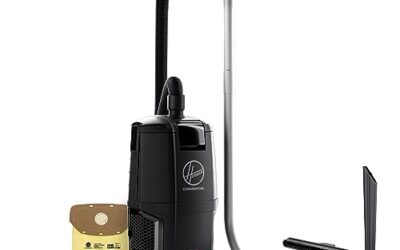
This is the pick for operations that want a purpose-built commercial machine without joining a power-tool battery platform first. The kit includes the 40V 8Ah battery and charger, so a supervisor can hand it to a new hire as a complete unit. Its HEPA Media filtration with Hexaguard technology works through allergen bags and final filters, and the two airflow modes let an operator drop to the quieter Hush setting in occupied offices, then switch to Boost for entranceways and heavier soil between charges.
Specs
- Power source: HVRPWR 40V battery system; 40V 8Ah lithium-ion battery and charger included
- Capacity: 6 qt
- Filtration: HEPA Media with Hexaguard technology
- Airflow: 66.75 CFM on Hush mode, 81.22 CFM on Boost mode
- Runtime: Up to 63 minutes with the included 8Ah battery
- Weight: 14.56 lbs with battery; 9.99 lbs product only
- Harness: Ergonomic harness design
Best for: Contract cleaners and facility teams buying a self-contained cordless kit for daytime routes in offices, schools and hotels.
Watch out for: Filtration depends on Hoover Commercial consumables, including the AH40006 HEPA media final filters and allergen bags, so confirm a steady supply before ordering several units.
Makita XCV17Z 18V X2 LXT (36V) Brushless Cordless HEPA Filter Backpack Dry Vacuum

For crews already carrying Makita 18V LXT batteries, this backpack turns the packs on the van into the longest listed runtime in this guide: up to 139 minutes on the normal setting with two 6.0Ah batteries. The two-stage HEPA filter is built for fine dust work, capturing 99.97 percent of particulates at 0.3 microns and larger, and the 1.6 gallon bag gives it the most capacity here. Padded shoulder straps and a waist belt spread the load, which matters on the long, low-power runs this machine is aimed at.
Specs
- Power source: Two 18V LXT lithium-ion batteries (36V total), sold separately; tool only
- Motor: BL Brushless motor
- Capacity: 1.6 gallon filter bag
- Filtration: Two-stage HEPA filter; captures 99.97% of particulates 0.3 microns and larger
- Airflow: 78 CFM
- Static water lift: 44 in.
- Runtime: Up to 139 minutes on normal setting, 40 minutes on max setting, with two 6.0Ah batteries
- Weight: 15 lbs with empty dust bag and two 18V 5.0Ah batteries
- Harness: Padded shoulder straps and waist belt with multiple adjustments
Best for: Cleaning contractors and maintenance teams already on the Makita LXT platform who need long, quiet runtime on large floors.
Watch out for: It ships as a bare tool, so the runtime figures assume two high-capacity 6.0Ah batteries you may need to buy separately; smaller packs shorten every figure above.
Milwaukee M18 FUEL 3-in-1 Backpack Vacuum (0885-20)

Milwaukee built this one for the cleanup that follows trades work rather than a nightly corridor route. The certified HEPA filter and cyclonic, bagless design suit drywall dust, wood shavings and jobsite debris, and the 3-in-1 body can be worn as a backpack, hung from its integrated hook, or carried by hand for spot work. A high and low switch keeps control simple, the debris canister empties without bags to stock, and the included dust extractor adapter connects it to tools, which is where its filtration earns its place on a renovation site.
Specs
- Power source: M18 battery platform, compatible with all M18 batteries; battery and charger sold separately
- Filtration: Certified HEPA filter
- Capacity: 1 gallon debris collection
- Modes: High/Low switch
- Collection: Bagless with cyclonic technology
- Design: 3-in-1 wear, hang or carry
- Included: 6 ft flex hose, HEPA filter, telescopic extension wand, crevice tool, floor tool and dust extractor adapter
- Weight: 15.3 lbs
Best for: Renovation, maintenance and facilities crews already using M18 batteries who need certified HEPA filtration for dusty cleanup work.
Watch out for: The 1 gallon canister is the smallest here and fills quickly with bulky debris, and as a bare tool it needs an M18 battery and charger from your existing kit.
Which One Fits Your Situation
You clean occupied offices, schools or clinics during the day
Choose the Hoover CH93600 kit. The Hush airflow mode is made for working around people, the battery and charger are in the box, and the bagged HEPA Media system keeps dust sealed when the operator empties the machine. It is the simplest of the three to hand to rotating staff, because there is no separate battery platform to manage or explain.
Your routes are long and your team already runs Makita batteries
Choose the Makita XCV17Z. Nothing else here approaches its listed 139 minutes on the normal setting, and the 1.6 gallon bag means fewer stops on big floors. Because it draws on the LXT packs your team already charges overnight, adding the vacuum does not start a second battery system with its own chargers, spares and replacement cycle to track.
You clean up after construction or renovation work
Choose the Milwaukee 0885-20. The certified HEPA filter, bagless cyclonic canister and dust extractor adapter fit a workflow of drywall dust and tool cleanup, and the wear-hang-carry body adapts to ladders, lifts and tight mechanical rooms. It runs on the same M18 packs as the crew’s drills and lights, so batteries rotate through the day instead of sitting dedicated to one machine.
You are buying a first cordless unit for a small cleaning firm
Start with the Hoover kit unless your vans already carry Makita or Milwaukee batteries. A first purchase has to work as a complete system on day one: machine, battery, charger and bags from a single box. The tool-only alternatives only become the cheaper route when the matching batteries are already on your shelf with cycles to spare.
Common Mistakes
- Comparing headline runtimes without checking the battery size and power mode behind each figure.
- Treating HEPA media, a two-stage HEPA system and a certified HEPA filter as the same claim when ordering replacement parts.
- Buying a tool-only vacuum for a team that does not already own that battery platform, then discovering the charger is a second purchase.
- Ignoring loaded weight: a backpack listed light without batteries rides very differently once two large packs are fitted.
- Sending a dry-only machine onto routes with wet entranceways or washroom spills and expecting it to cope.
Frequently Asked Questions
Is HEPA media the same as a certified HEPA filter?
Not exactly. HEPA media means the filter material meets the HEPA standard and usually works as one stage inside a bagged system, as on the Hoover. A certified HEPA filter, like the Milwaukee’s, is a tested component in its own right. Both appear on commercial listings; what matters is matching the claim to your facility’s dust requirements and keeping the correct replacement filters in stock.
How much runtime does a route actually need?
Count trigger time, not shift length. An operator walking a corridor route may run the motor for half the shift, so a listed 60 to 90 minutes can cover it, while continuous work on one large floor cannot. The Makita’s listed 139 minutes on its normal setting suits the second case. Whatever you choose, a second set of charged batteries removes the question entirely.
Can any of these vacuums handle wet spills?
No. All three machines in this guide are dry vacuums, built for dust and dry debris. Liquid can damage the motor and ruin HEPA filtration in a single pass. Buildings with frequent spills, wet entranceways or washroom routes need a separate wet and dry machine in the fleet, and operators should know which unit comes out for which call before the shift starts.
What consumables should I plan to keep in stock?
Each system differs. The Hoover uses allergen bags plus HEPA media final filters and a Hexaguard filter. The Makita uses 1.6 gallon filter bags and its two-stage HEPA element. The Milwaukee is bagless, so its certified HEPA filter is the main scheduled replacement. Stocking the right bags and filters per machine keeps the filtration performing as listed instead of clogging early.